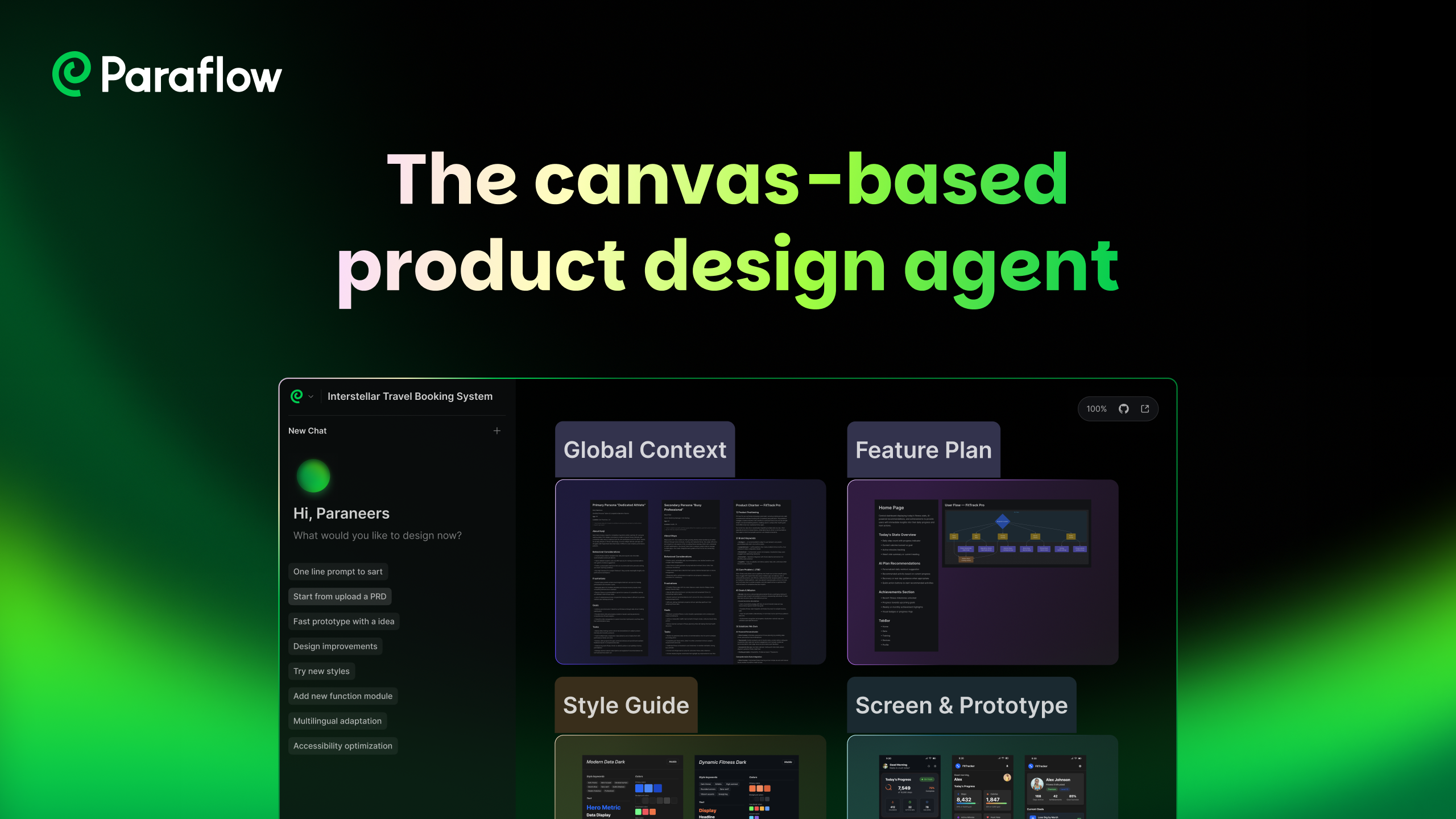
Paraflow Review: The Canvas-Based AI Product Design Agent Bridging Idea and Code
The canvas-based product design agent.
Published: 11/18/2025
Paraflow enters the increasingly crowded AI productivity space with a focused and ambitious goal: to transform the abstract process of product ideation into immediately actionable, structured design specifications. Billed as "The canvas-based product design agent," Paraflow promises to simulate an entire foundational product team—a Product Manager (PM) and a Designer—working in tandem on a unified canvas. For founders, solo developers, or small teams wrestling with the chaotic transition from napkin sketch to functional specification, Paraflow might just offer the structure they desperately need.
Product Overview: AI Collaboration on a Unified Canvas
Paraflow isn't just another generative AI tool; it’s framed as a collaborative design agent system. It seeks to eliminate the common friction points where product vision breaks down—namely, the misalignment between initial requirements (PRDs), user experience mapping (user flows), and visual execution (prototypes). By housing these core artifacts within a single, dynamic canvas, Paraflow aims to ensure that all outputs remain intrinsically connected and updated.
The target audience for Paraflow is clear: anyone involved in early-stage product creation who needs to rapidly establish structure without immediately onboarding extensive human resources. This includes solo entrepreneurs launching an MVP, agencies prototyping client solutions quickly, or even product managers looking to accelerate the documentation phase of a new feature. The core value proposition rests on delivering structured specs that are richer, require fewer corrective prompts, and maintain professional alignment from the outset.
Problem & Solution: Taming Specification Chaos
The perennial problem in digital product development is specification drift. An initial idea sparks a great user flow, but when the PM writes the PRD, those requirements change, and the designer’s initial mockups suddenly don't map correctly to the latest feature list. This disconnect leads to scope creep, endless revision cycles, and significant technical debt before the first line of production code is even written.
Paraflow directly attacks this inefficiency by operating as an intelligent bridge. Instead of demanding separate inputs for requirements and design, it uses two specialized AI minds—the PM and the Designer—to co-create specs. This simultaneous, iterative process ensures that when the PM refines a requirement, the Designer's flow/prototype implications are immediately considered, and vice versa. This synergistic approach fills a crucial market gap: tools that automate the alignment process itself, not just the individual document creation.
Key Features & Highlights: Structured Design Automation
The true innovation in Paraflow appears to be the dual-agent architecture operating on the shared canvas. Users benefit from features that translate high-level concepts into meticulously organized output:
- Dual-Agent Synergy: The core strength is the simulated PM/Designer team working together. This likely means outputs are contextually aware of both business requirements and usability standards simultaneously.
- Unified Artifact Generation: The ability to generate integrated PRDs, User Flows, and Prototypes on one visual plane is a significant productivity booster. This centralization drastically reduces the manual effort traditionally spent aligning documents across disparate tools (like Notion, Figma, and Jira).
- Richer, Controlled Specs: By enforcing consistency through its internal AI alignment, Paraflow promises specifications that are inherently more detailed and less prone to ambiguity, leading to cleaner handoffs to engineering teams.
The user experience hinges on the responsiveness of this canvas. A successful implementation would mean users spend less time managing document versions and more time iterating on core concepts, driven by AI suggestions that respect the defined product architecture.
Potential Drawbacks & Areas for Improvement
While the concept is revolutionary, the success of Paraflow will ultimately depend on the depth and fidelity of the AI outputs. A potential drawback lies in the complexity of handling highly niche or deeply technical product requirements. If the system relies too heavily on generalized design patterns, users working in specialized B2B enterprise software or heavily regulated industries might find the generated specs too generic or requiring extensive manual correction.
For enhancement, I suggest an emphasis on Integration Depth. While generating specs is powerful, the next logical step is tighter integration with development tools. Can Paraflow automatically generate Jira tickets based on user flow acceptance criteria? Can it map specific design components directly to a Storybook library? Furthermore, offering customizable "Persona Profiles" for the AI team—allowing users to set the PM’s focus (e.g., growth vs. compliance) or the Designer’s style guide adherence—would significantly boost perceived control and utility for professional users.
Bottom Line & Recommendation
Paraflow represents an exciting evolution in AI-assisted product development, moving beyond simple content generation toward complex, structured system design. It is an absolute must-try for solo founders and early-stage startup teams looking to rapidly prototype and pressure-test their core product vision with structured documentation. If you struggle with keeping your PRDs, user flows, and initial prototypes in lockstep, Paraflow offers a compelling, centralized solution. This tool has the potential to dramatically compress the crucial, yet often painful, phase between a solid idea and a set of genuinely professional, ready-to-build specifications.
Featured AI Applications
Discover powerful tools to enhance your productivity
MindMax
New Way to Interact with AI
Beyond AI chat, transforming conversations into an infinite canvas. Combining brainstorming, mind mapping, critical and creative thinking tools to help you visualize ideas, solve problems efficiently, and accelerate learning.
AI Slides
AI Slides with Markdown
Revolutionary slide creation fusing AI intelligence with Markdown flexibility - edit anywhere, optimize anytime, iterate easily. Turn every idea into a professional presentation instantly.
AI Markdown Editor
Write Immediately
Extremely efficient writing experience: AI assistant, slash commands, minimalist interface. Open and write, easy writing. ✍️ Markdown simplicity + 🤖 AI power + ⚡ Slash commands = Perfect writing experience.
Chrome AI Extension
AI Assistant Anywhere
Transform your browsing experience with FunBlocks AI Assistant. Your intelligent companion supporting AI-driven reading, writing, brainstorming, and critical thinking across the web.