How to Use the Lattice of Mental Models in AIFlow
When faced with a complex challenge, asking a standard AI for advice often yields generic and unhelpful suggestions. Inspired by Charlie Munger's Latticework of Mental Models, AIFlow provides a powerful multi-dimensional thinking tool to help you solve hard problems by analyzing them from multiple, cross-disciplinary perspectives.
Here is a step-by-step tutorial on how to use AIFlow's Latticework of Mental Models framework to triangulate truth, uncover hidden failure modes, and generate non-obvious insights.
What is the Latticework of Mental Models?
Charlie Munger famously observed that "To the man with a hammer, everything looks like a nail." To avoid this trap, he advocated building a latticework of 80 to 100 mental models drawn from various disciplines—like biology, economics, physics, and psychology—to analyze any given situation simultaneously.
AIFlow integrates this philosophy directly into its mind mapping engine, creating a structured, visual thinking tool tailored for deep problem-solving.
Step 1: Input Your Complex Problem
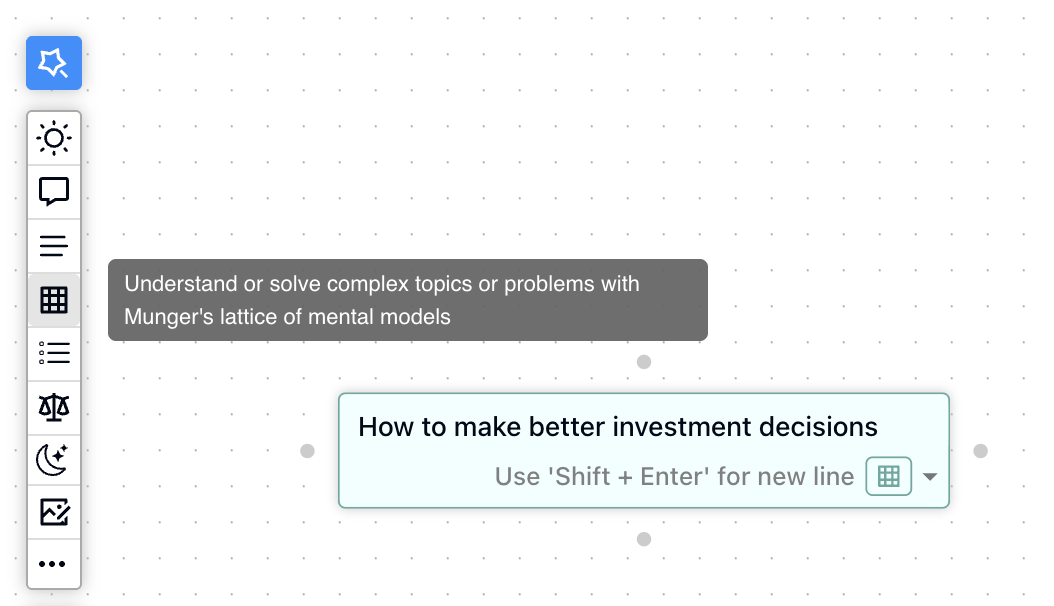
Begin by creating a new node (click the "Lattice of Mental Models" button in the left of the canvas) in your AIFlow canvas and typing in your complex problem or core topic. This could be a business challenge, a strategic decision, or a learning objective:
- "Why is my SaaS product experiencing high churn?"
- "How should I approach scaling my operations?"
- "What are the second-order effects of remote work on company culture?"
AIFlow doesn't just answer the question; it prepares to analyze it across multiple dimensions.
Step 2: Trigger the Mental Models Analysis
With your problem node selected, use AIFlow's AI assistant tools to start the analysis. AIFlow will automatically select 6 to 8 of the most relevant mental models from Munger's latticework—chosen specifically because they illuminate distinct facets of your unique problem.
For example, if analyzing user churn, AIFlow might apply:
- Feedback Loops (Systems Thinking)
- Loss Aversion (Behavioral Psychology)
- Ecosystem Adaptation (Biology)
- Opportunity Cost (Economics)
This generates a structured, multi-branch mind map.
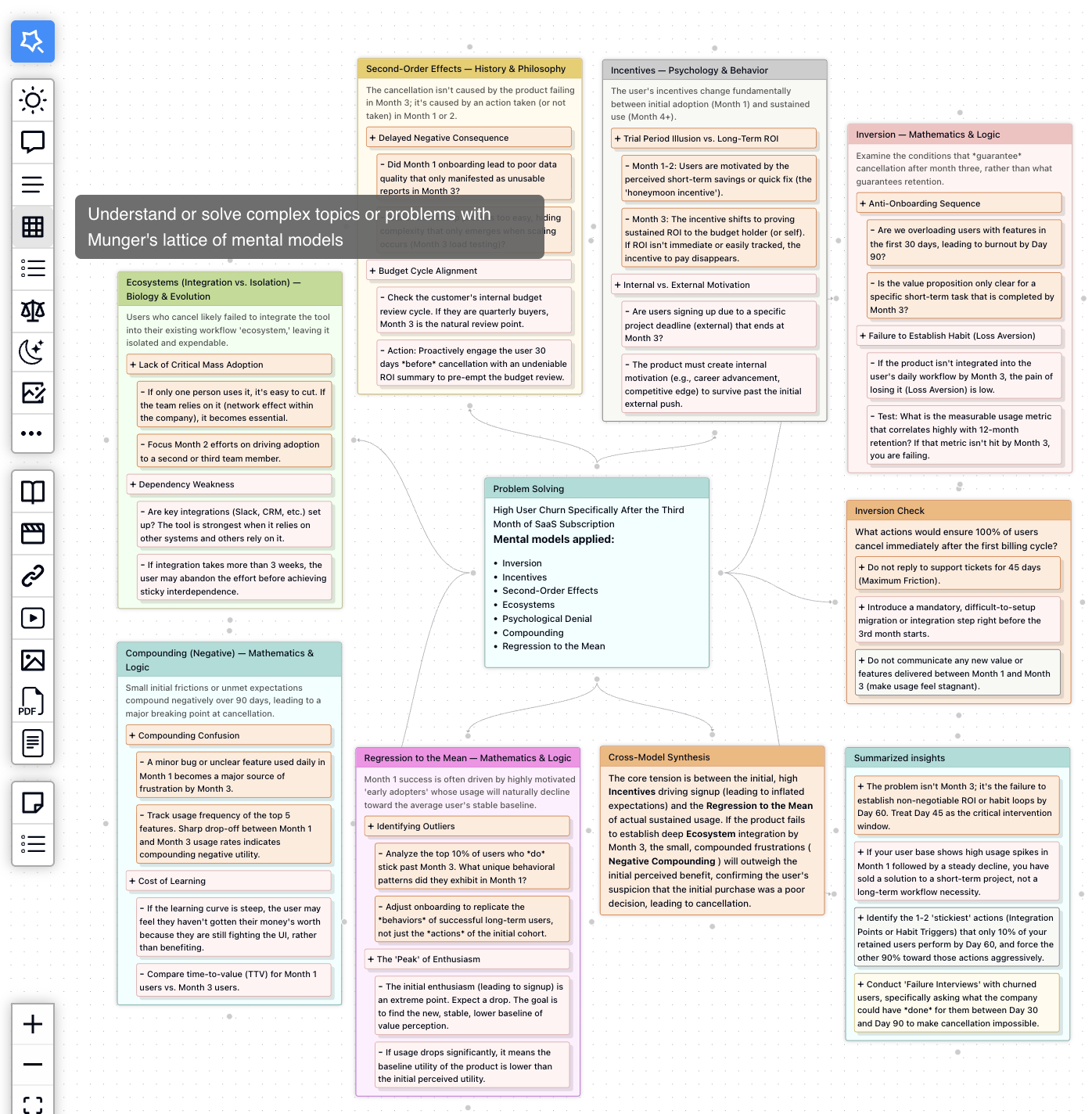
Step 3: Run the Inversion Check
Munger's favorite technique is: "Invert, always invert."
AIFlow incorporates an Inversion Check before surfacing any solutions. It will ask: "What would guarantee failure?"
Look at the generated inversion branch. By explicitly mapping out the failure modes, you can often find that avoiding failure is much more actionable than chasing success. For instance, fixing an onboarding process that teaches users the wrong habits is often easier than inventing a shiny new feature.
Step 4: Review Cross-Disciplinary Perspectives
Dive into the branches generated for each mental model. AIFlow ensures a strict quality standard: each model must illuminate a genuinely distinct facet of the problem.
- Psychology (Loss Aversion): What psychological threshold are users crossing?
- Logic (Second-Order Effects): What happens downstream when a decision is made?
By reviewing these separate lenses, you avoid generic domain-specific advice and build a comprehensive map of the entire problem space.
Step 5: Synthesize for Bold Insights
Individual models give you fragments; synthesis gives you understanding.
In AIFlow, the real magic happens when you look at the Cross-Model Synthesis. Reflect on how the models interact:
- Convergence: Where do multiple models point to the same leverage point? That convergence is your highest-priority action.
- Tension: Where do models create tension with each other? (e.g., adding more notifications vs. avoiding notification fatigue). These tensions represent crucial trade-offs.
AIFlow uses this synthesis to provide insights that are specific, actionable, and counterintuitive—reframing your entire understanding of the solution.
Conclusion
By leveraging AIFlow's Lattice of Mental Models, you transition from receiving simple answers to building a robust thinking framework. Whether you are a founder diagnosing growth, an investor evaluating risks, or anyone facing high-stakes decisions, AIFlow equips you with the structured intellectual rigor necessary for profound problem-solving.