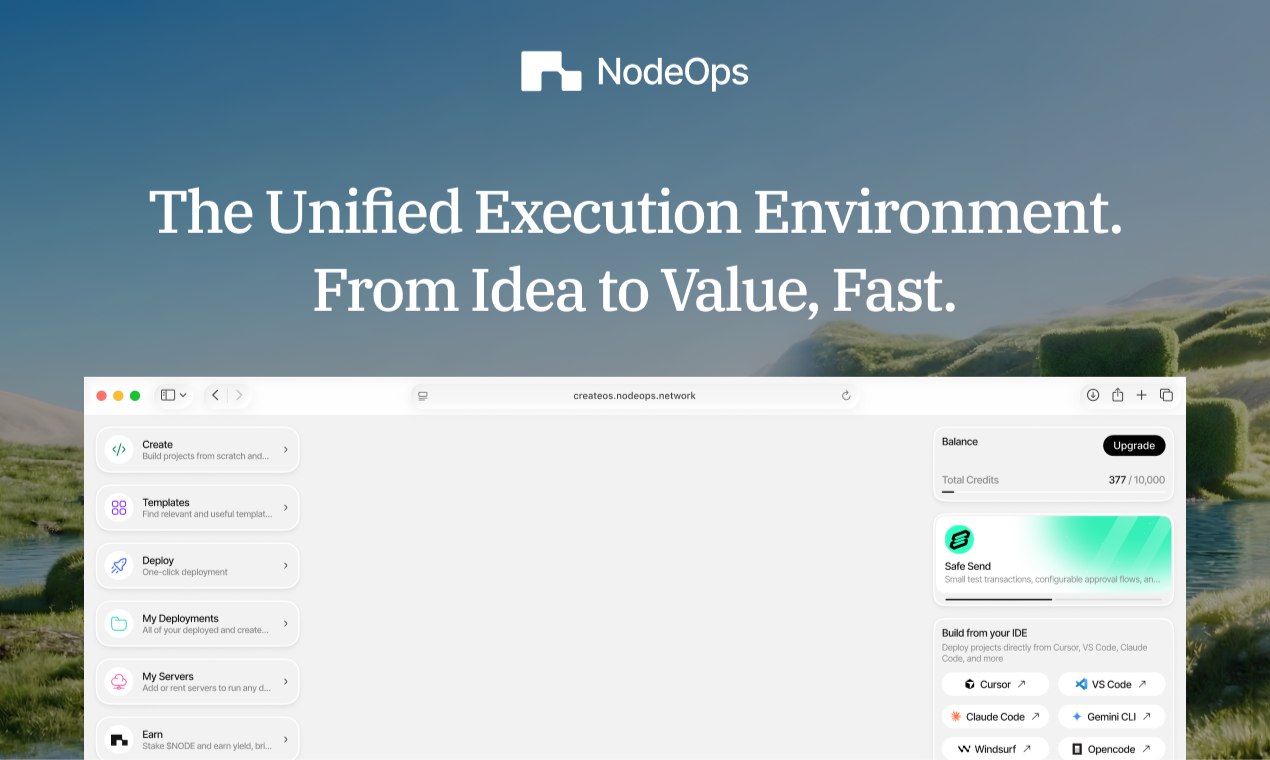
CreateOS: The Unified Workspace Finally Taming the AI Development Chaos
Build and deploy apps from any AI coding tool, in one place
Published: 2/4/2026
Product Overview: Bridging AI Code Generation and Deployment
CreateOS enters the increasingly crowded—yet paradoxically fragmented—developer tooling landscape with a bold promise: to be the single pane of glass for the entire application lifecycle, specifically optimized for workflows driven by modern AI coding assistants. In essence, CreateOS is marketed as a unified workspace designed to take raw code output from tools like GitHub Copilot or Claude 3 and shepherd it seamlessly through building, testing, and deployment.
The core target audience here is clear: startups, independent developers, and product teams who are leveraging AI for rapid prototyping but quickly hit a wall when trying to move that generated code into a reliable, scalable production environment. This tool aims to eliminate the painful "tool sprawl" where developers juggle separate platforms for version control, CI/CD pipelines, containerization, and hosting.
The fundamental value proposition of CreateOS is velocity combined with simplification. By abstracting away complex DevOps configurations, it allows builders to maintain momentum (product focus) rather than getting bogged down in infrastructure management.
Problem & Solution: Solving the AI-to-Production Bottleneck
The modern development environment is littered with specialized tools. When a developer generates a functional prototype using an AI agent, they are immediately faced with the manual task of setting up repositories, configuring build scripts (like Dockerfiles), managing cloud accounts, and setting up continuous integration. This transition from concept to cloud is often the slowest and most frustrating part of the development cycle.
CreateOS directly addresses this friction point. It positions itself as the necessary layer that sits between the generative AI coding tools and the cloud infrastructure. Instead of integrating five separate services, users funnel their AI-generated application structure directly into CreateOS, which handles the necessary plumbing—the configuration of deployment environments, scaling policies, and monitoring hooks—automatically. This dramatically shortens the time-to-market for AI-assisted projects, filling a crucial gap where AI output currently stalls before reaching end-users.
Key Features & Highlights: Speed, Focus, and Integration
While the specific technical deep dives aren't available, the description points toward a set of highly integrated features centered around operational efficiency. The emphasis on "no DevOps" suggests significant automation under the hood.
Key highlights appear to revolve around streamlining the deployment process:
- Unified Workflow: Integrating build, deploy, and scale actions into a single interface removes context switching, a major drain on developer productivity.
- AI Tool Agnostic: Being able to accept code from any AI coding tool means developers aren't locked into a specific ecosystem, maximizing flexibility.
- Focus on Momentum: By handling infrastructure configuration (likely via sensible defaults and automation), the platform ensures developers spend their time refining features, not debugging YAML files.
- Scalability Built-In: The promise to "scale apps" suggests that the underlying infrastructure managed by CreateOS is robust enough to handle growth without requiring a migration later on.
The user experience highlight is implicitly the sheer reduction in required knowledge; a developer proficient in writing code via AI can potentially become a deployer in the same session, a massive win for speed and focus.
Potential Drawbacks & Areas for Improvement
Any platform promising to replace extensive DevOps tooling must be approached with realistic expectations. The primary challenge for CreateOS will be depth versus breadth.
A key area for scrutiny will be customization. While abstracting complexity is great for 80% of use cases (standard web apps, APIs), advanced developers often need granular control over networking, specific database configurations, or specialized cloud services. If CreateOS locks users into opinionated infrastructure choices, it could frustrate power users who need specific compliance or performance tuning that the automated layer doesn't expose.
Suggestions for enhancement would include:
- Granular Overrides: Providing an easy "escape hatch" to access or modify the underlying configuration files (like Terraform or Kubernetes manifests) for expert users who need fine-tuning.
- Monitoring Visibility: Clearly articulating what monitoring and logging solutions are integrated by default, and how developers can ingest that data into their external tools if necessary.
- Cost Transparency: Since infrastructure is being managed, transparent, real-time cost estimation based on usage is crucial for budget-conscious startups.
Bottom Line & Recommendation
CreateOS appears to be a timely and necessary abstraction layer for the AI-driven development era. If your primary bottleneck isn't writing code but rather fighting with CI/CD pipelines and cloud provider settings after generating that code with an AI assistant, this tool demands your attention.
Who should try this product? Early-stage founders, solo developers, and small engineering teams focused on rapid iteration using generative AI coding tools.
Overall, CreateOS offers a compelling proposition to deliver on the promise of AI productivity: turning generated code into deployed applications faster than ever before. It’s highly recommended for anyone tired of the DevOps overhead slowing down their product momentum.
Featured AI Applications
Discover powerful tools to enhance your productivity
MindMax
New Way to Interact with AI
Beyond AI chat, transforming conversations into an infinite canvas. Combining brainstorming, mind mapping, critical and creative thinking tools to help you visualize ideas, solve problems efficiently, and accelerate learning.
AI Slides
AI Slides with Markdown
Revolutionary slide creation fusing AI intelligence with Markdown flexibility - edit anywhere, optimize anytime, iterate easily. Turn every idea into a professional presentation instantly.
AI Markdown Editor
Write Immediately
Extremely efficient writing experience: AI assistant, slash commands, minimalist interface. Open and write, easy writing. ✍️ Markdown simplicity + 🤖 AI power + ⚡ Slash commands = Perfect writing experience.
Chrome AI Extension
AI Assistant Anywhere
Transform your browsing experience with FunBlocks AI Assistant. Your intelligent companion supporting AI-driven reading, writing, brainstorming, and critical thinking across the web.