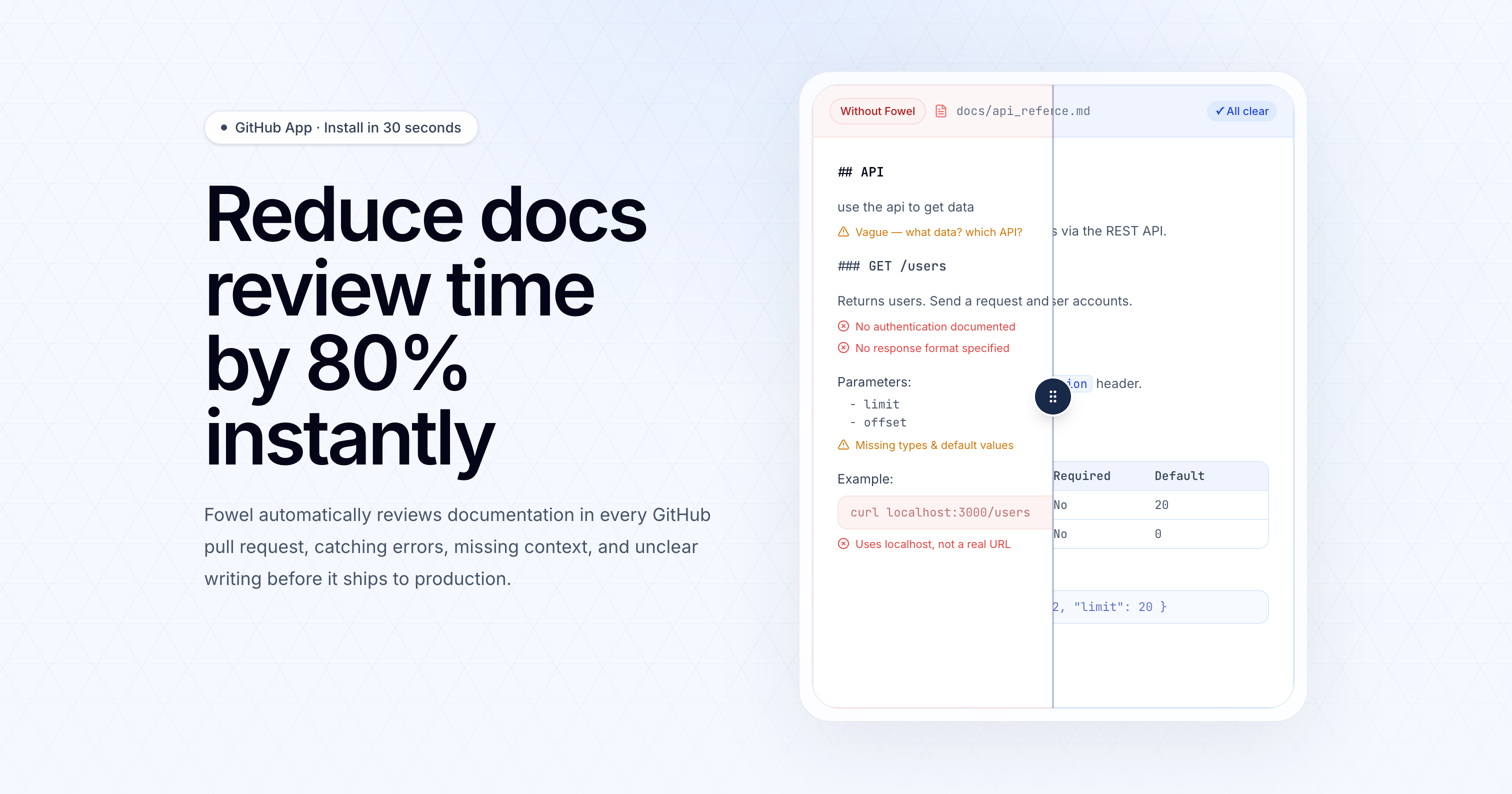
Fowel by Hackmamba Review: The 80% Time Saver for Seamless GitHub Documentation Review
Reduce documentation review time by 80% instantly
Published: 3/13/2026
Product Overview
Fowel by Hackmamba enters the crowded developer tooling space with a highly specific, yet critically important, value proposition: drastically cutting down the time spent reviewing documentation attached to GitHub pull requests. In the fast-paced world of software development, documentation review is often the tedious bottleneck—a necessary evil that frequently gets rushed, leading to technical debt in the form of inaccurate, incomplete, or outdated guides and READMEs. Fowel aims to automate this crucial quality gate, ensuring that documentation keeps pace with code changes automatically.
This tool is laser-focused on development teams, technical writers embedded within engineering departments, and DevOps professionals who rely on accurate runbooks and setup instructions. Its core function is to act as an intelligent, automated reviewer that scans documentation files (likely Markdown, RST, or similar formats within the repo) attached to any new PR, flagging issues before a human reviewer even needs to open the file. The promise of reducing review time by an astonishing 80% is bold and immediately targets developers suffering from documentation fatigue.
The core value proposition of Fowel is efficiency married to quality assurance. By integrating seamlessly into the CI/CD or PR workflow, it elevates documentation from an afterthought to a mandatory, machine-verified step. This allows human reviewers to focus their limited attention on complex code logic rather than syntax errors, broken code snippets, or missing essential steps in the documentation set.
Problem & Solution
The specific problem Fowel tackles is the high cognitive load and time sink associated with manual documentation validation during code reviews. When a developer submits a PR that modifies associated documentation, a maintainer must: 1) verify the code matches the documentation, 2) check if the documentation is clear, 3) ensure all new features or deprecations are noted, and 4) confirm code samples within the documentation are runnable and accurate against the new code. This manual checking process is prone to human error and is highly repetitive across hundreds of PRs.
Fowel solves this by transforming this subjective, manual check into an objective, automated validation process. It leverages machine intelligence to spot common documentation pitfalls: structural gaps (e.g., missing prerequisites), context drift (where the text describes an old version), and, most importantly, outdated code samples that no longer compile or execute correctly against the branch being merged. Unlike general linters, Fowel appears contextually aware of its role within the GitHub ecosystem, integrating directly where the action happens.
Key Features & Highlights
The power of Fowel by Hackmamba lies in its simplicity of deployment and the depth of its automated analysis. The setup promise of "install in 30 seconds" suggests a lightweight, highly accessible integration, which is critical for rapid adoption in any engineering organization.
The key features driving this efficiency include:
- Automated PR Scanning: Fowel hooks directly into the pull request lifecycle, scanning documentation files instantly upon PR creation or update.
- Inaccuracy Detection: It actively looks for inconsistencies between the documentation content and the underlying code changes in the PR.
- Context Validation: Crucial for APIs or complex setups, Fowel flags missing context or steps required for users to successfully utilize the updated features.
- Scalability: The platform explicitly supports unlimited repositories, making it viable for large organizations managing monorepos or vast collections of microservice documentation.
The user experience highlight is clearly the proactive nature of the tool. Instead of waiting for a reviewer to spend 15 minutes chasing a broken command example, Fowel surfaces the issue immediately, often within the PR timeline itself, allowing the author to fix it before human eyes even examine the ticket.
Potential Drawbacks & Areas for Improvement
While the promise of Fowel is revolutionary for documentation hygiene, its current iteration might face challenges related to complexity and nuance. Automated documentation tools can sometimes be overly aggressive or lack the true understanding of developer intent.
One potential drawback is the depth of structural gap analysis. While it can check for missing headers or boilerplate, deep contextual reviews—such as confirming a complex architectural diagram accurately reflects the system architecture described in prose—might still require human oversight. Developers might initially find they are spending time addressing false positives flagged by Fowel’s parsing engine, slightly eroding the 80% time-saving guarantee until the model learns their specific conventions.
To enhance Fowel further, I would suggest:
- Customizable Linting Rules: Allow teams to define specific "golden paths" or required sections for documentation based on project type (e.g., mandatory setup steps for configuration files).
- Integration with Code Execution: If technically feasible, the ultimate feature would be to attempt a basic compilation or execution of embedded code samples against the linked code branch to confirm absolute accuracy, moving beyond simple text matching.
Bottom Line & Recommendation
Fowel by Hackmamba is an essential tool for any modern engineering team prioritizing developer experience and time efficiency. If your team struggles with reviewers constantly pointing out outdated READMEs or broken setup instructions on every pull request, Fowel offers a compelling, automated solution to enforce documentation quality gates.
For teams managing numerous repositories or those operating under high-velocity release schedules, the promise of reducing documentation review time by 80% makes Fowel an immediate candidate for a pilot program. It shifts the burden of tedious verification away from highly paid engineers, freeing them to focus on innovation. It’s a strong contender in the developer productivity space and well worth exploring for documentation-heavy workflows.
Featured AI Applications
Discover powerful tools to enhance your productivity
MindMax
New Way to Interact with AI
Beyond AI chat, transforming conversations into an infinite canvas. Combining brainstorming, mind mapping, critical and creative thinking tools to help you visualize ideas, solve problems efficiently, and accelerate learning.
AI Slides
AI Slides with Markdown
Revolutionary slide creation fusing AI intelligence with Markdown flexibility - edit anywhere, optimize anytime, iterate easily. Turn every idea into a professional presentation instantly.
AI Markdown Editor
Write Immediately
Extremely efficient writing experience: AI assistant, slash commands, minimalist interface. Open and write, easy writing. ✍️ Markdown simplicity + 🤖 AI power + ⚡ Slash commands = Perfect writing experience.
Chrome AI Extension
AI Assistant Anywhere
Transform your browsing experience with FunBlocks AI Assistant. Your intelligent companion supporting AI-driven reading, writing, brainstorming, and critical thinking across the web.