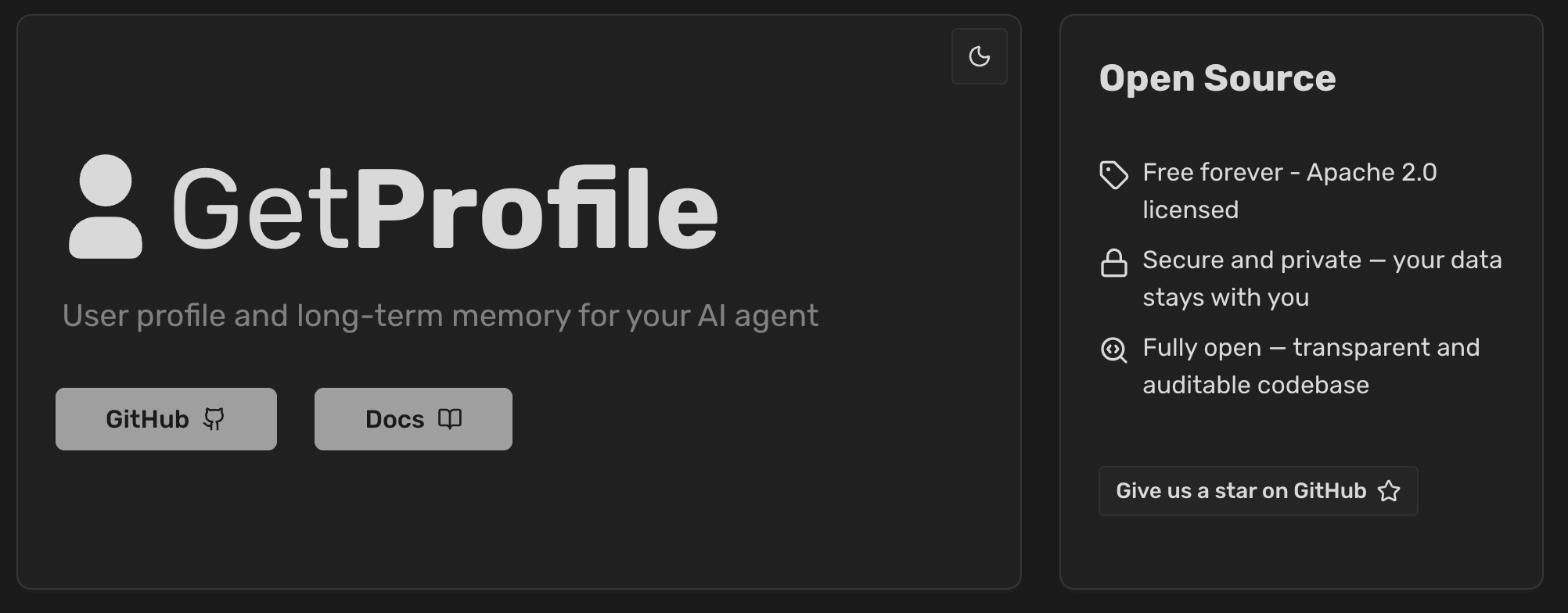
GetProfile: Revolutionizing AI Agent Personalization with Structured Long-Term Memory
User profiles and long-term memory for your AI agents
Published: 12/21/2025
Product Overview
GetProfile enters the burgeoning field of AI agent development with a compelling proposition: providing structured, self-hosted, and open-source user profiles and long-term memory for autonomous AI agents. In an ecosystem where many AI applications rely on ephemeral session context or simple vector databases, GetProfile offers a significant leap forward in creating truly personalized and context-aware digital assistants or agents. It moves beyond storing raw, unorganized data blobs, focusing instead on building a rich, accessible, and queryable understanding of the end-user.
This tool is squarely aimed at developers, startups, and enterprises building sophisticated conversational AI, customer service bots, personalized learning platforms, or complex automation agents that require consistent, nuanced user recall. The core value proposition of GetProfile is transforming unstructured interaction data into actionable, structured intelligence, ensuring that every subsequent interaction benefits from a deeply contextualized understanding of the user’s history, preferences, and attributes.
The self-hosted and open-source nature further enhances its appeal, particularly for organizations concerned with data sovereignty, privacy compliance, or the desire for deep customization without vendor lock-in associated with closed-source memory solutions.
Problem & Solution: Moving Beyond Generic Context
The central problem GetProfile solves is the "forgetfulness" inherent in many current Large Language Model (LLM) applications. Standard memory solutions often involve basic summarization or embedding search across an entire conversation history. This approach is inefficient, slow, and struggles to retain long-term, critical facts about a user over multiple sessions—a necessity for truly personalized experiences.
GetProfile addresses this by introducing structured data extraction. Instead of just storing text, it actively processes interactions to pull out distinct, typed traits (e.g., "User preference: Dark Mode," "Hobby: Astrophysics"), assigns confidence scores to these traits, and identifies memories tagged with importance levels. By leveraging a familiar, robust backend like PostgreSQL, GetProfile offers a reliable, searchable structure for these extracted facts, bridging the gap between raw AI output and persistent, usable user data records. This structured approach fills a clear market gap for developers needing high-fidelity, controlled long-term personalization.
Key Features & Highlights
The architecture of GetProfile sets it apart, focusing on semantic richness and data ownership. The most notable capabilities revolve around deep data structuring:
- Structured Trait Extraction: Unlike simple key-value stores, GetProfile intelligently parses natural language interactions to identify and catalog explicit user attributes. The inclusion of confidence scores is crucial, allowing agents to know when they are certain about a user trait versus when they are inferring—a key component for responsible AI behavior.
- Importance-Ranked Memories: It doesn't just archive everything; it prioritizes. Memories deemed highly relevant to the user's core goals or frequent topics are flagged with importance levels. This ensures that when an agent needs to recall critical information, it retrieves the most pertinent context first, optimizing latency and relevance.
- Self-Hosted and Open-Source: For developers focused on security and scalability, the ability to deploy GetProfile within their own infrastructure using PostgreSQL is a massive advantage. This design choice ensures maximum control over data residency and customization of the memory schema.
- Natural Language Summarization: Alongside structured data, it retains accessible natural language summaries, providing a human-readable overview of the agent's understanding of the user at any point in time.
The user experience, from the developer’s perspective, is streamlined by focusing on exporting data into a database standard they likely already use, minimizing the learning curve associated with bespoke memory solutions.
Potential Drawbacks & Areas for Improvement
While the core concept of structured, self-hosted memory is powerful, there are inherent challenges that potential users should consider. The reliance on the quality of the underlying LLM for the initial extraction is a key vulnerability; if the model misinterprets a conversation, the structured data in GetProfile will be flawed ("Garbage In, Garbage Out").
Constructive feedback centers on the integration surface area:
- API/SDK Maturity: Since this is a foundational component, robust, easy-to-use SDKs for popular agent frameworks (like LangChain or AutoGen) would significantly accelerate adoption.
- Data Reconciliation Tools: Developers will need clear tools or pipelines for manually reviewing and correcting confidence scores or traits flagged as low-confidence, offering a user interface layer on top of the PostgreSQL backend for profile management.
- Scaling for High-Throughput Agents: While PostgreSQL is robust, documentation or benchmarks on scaling the profile database layer to handle thousands of concurrent agents requiring rapid memory lookups would be beneficial for enterprise planning.
Bottom Line & Recommendation
GetProfile is an essential piece of infrastructure for any team serious about developing AI agents that exhibit true long-term memory and personalization, moving them beyond stateless interactions. If your current AI framework suffers from short-term memory loss, or if data privacy mandates self-hosting, GetProfile offers an elegant, structured solution built on open standards.
I highly recommend that AI engineers, startup founders building custom assistants, and enterprise AI architects explore GetProfile. It provides the necessary architecture to build agents that don't just converse, but actually remember and adapt over time. This tool represents a significant step toward creating truly intelligent, personalized AI companions.
Featured AI Applications
Discover powerful tools to enhance your productivity
MindMax
New Way to Interact with AI
Beyond AI chat, transforming conversations into an infinite canvas. Combining brainstorming, mind mapping, critical and creative thinking tools to help you visualize ideas, solve problems efficiently, and accelerate learning.
AI Slides
AI Slides with Markdown
Revolutionary slide creation fusing AI intelligence with Markdown flexibility - edit anywhere, optimize anytime, iterate easily. Turn every idea into a professional presentation instantly.
AI Markdown Editor
Write Immediately
Extremely efficient writing experience: AI assistant, slash commands, minimalist interface. Open and write, easy writing. ✍️ Markdown simplicity + 🤖 AI power + ⚡ Slash commands = Perfect writing experience.
Chrome AI Extension
AI Assistant Anywhere
Transform your browsing experience with FunBlocks AI Assistant. Your intelligent companion supporting AI-driven reading, writing, brainstorming, and critical thinking across the web.