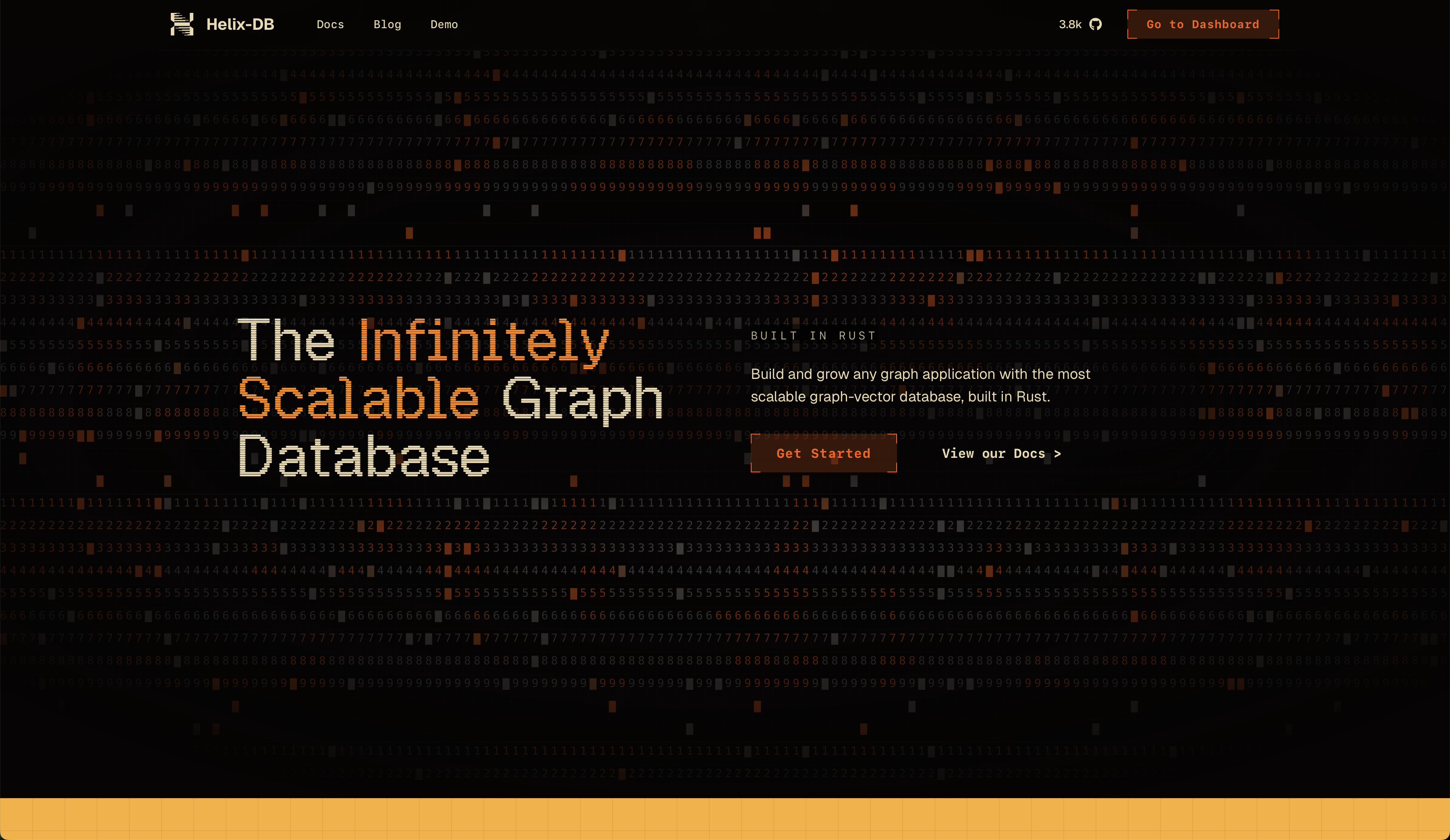
HelixDB Review: The Open-Source Fusion of Graph and Vector Databases in Rust
An open-source OLTP graph-vector database built in Rust.
Published: 2/27/2026
Product Overview: A New Contender in Data Infrastructure
HelixDB bursts onto the scene with a compelling proposition: an open-source OLTP graph-vector database built entirely in Rust. In an ecosystem often dominated by siloed solutions—one database for transactional workloads, another for graph analysis, and yet another for vector similarity search—HelixDB aims to unify these capabilities under one high-performance roof. This dual nature, supporting both intricate relationship querying (graph) and high-dimensional data retrieval (vector embeddings), positions it uniquely for modern application development.
The tagline clearly signals its ambition: to serve everyone from the "indie hacker building custom agent memory" to enterprise-level clients needing "infinitely scalable and highly available" solutions. This dual focus suggests HelixDB is not just another niche tool but an attempt to create a fundamental piece of data infrastructure optimized for the next generation of AI-powered applications where relational context and semantic understanding are paramount.
The foundation in Rust immediately signals a commitment to performance, memory safety, and concurrency—critical factors for any serious Online Transaction Processing (OLTP) system. For developers and architects looking to modernize their data stack without sacrificing speed or reliability, HelixDB presents a genuinely intriguing option worth deep exploration.
Problem & Solution: Unifying Context and Semantics
The contemporary challenge in building sophisticated applications, especially those leveraging Large Language Models (LLMs) and AI agents, is data fragmentation. Developers often juggle separate databases: a transactional store for core data, a graph database for complex relationships, and a dedicated vector store for Retrieval-Augmented Generation (RAG) or semantic search. This leads to operational overhead, increased latency due to cross-database joins, and complex data synchronization.
HelixDB solves this by integrating graph capabilities (modeling relationships) and vector indexing (modeling semantic similarity) within a single, high-throughput OLTP framework. This synergy allows applications to query what is related and how similar it is, all within the same system. By being built in Rust, it targets the market gap left by performance-limited alternatives, offering a durable, low-latency solution for workloads that demand both transactional integrity and advanced indexing techniques.
Key Features & Highlights: Performance Meets Versatility
The core strength of HelixDB lies in its technological stack and its dual-purpose architecture. The choice of Rust is a major highlight, promising superior performance characteristics often associated with systems programming languages, which is essential for any database marketed as 'infinitely scalable.'
Key areas where HelixDB shines include:
- Graph Querying: Allowing for complex traversal and relationship analysis inherent in graph databases.
- Vector Search: Providing fast, nearest-neighbor lookups crucial for AI/ML features like RAG and personalized recommendations.
- OLTP Focus: Ensuring that transactional workloads—reads and writes—are handled reliably and efficiently, distinguishing it from read-heavy analytical graph databases.
- Scalability & Availability: Promising enterprise-grade readiness for high-demand environments.
For users building sophisticated custom agent memory systems, the ability to store transactional facts (graph nodes/edges) alongside their semantic embeddings (vector attributes) in one performant engine is a significant advantage in simplifying architecture.
Potential Drawbacks & Areas for Improvement
As a relatively new, open-source product that has just reached General Availability, HelixDB faces the natural challenges of maturity. While the technical foundation in Rust is a strength, the ecosystem around it—tooling, community support, and comprehensive documentation—will be crucial differentiators moving forward.
Constructive suggestions for the team behind HelixDB would focus on rapidly building out this ecosystem:
- Documentation & Tutorials: Providing detailed guides specifically on integrating graph/vector queries together, perhaps with sample use cases relevant to modern AI workflows.
- Driver Support: Expanding official client libraries for popular languages beyond the core Rust ecosystem (e.g., Python, Node.js) would drastically lower the barrier to entry for many indie hackers and enterprise developers.
- Benchmarking Transparency: Publishing clear, rigorous benchmarks comparing its fused performance against leading dedicated graph and vector databases would help solidify its performance claims for Fortune 500 adoption.
Bottom Line & Recommendation
HelixDB is an ambitious and technologically sound entry into the database space, expertly fusing graph, vector, and OLTP capabilities into a high-performance Rust foundation.
Who should try it? Developers and architects focused on building the next wave of AI applications—specifically those requiring complex contextual understanding (graph) alongside semantic search (vector) within a transactional environment—should absolutely star the repo and begin evaluation. If you've felt the friction of stitching together Neo4j/ArangoDB, Chroma/Pinecone, and PostgreSQL, HelixDB offers a unified, high-performance alternative that warrants your immediate attention.
Featured AI Applications
Discover powerful tools to enhance your productivity
MindMax
New Way to Interact with AI
Beyond AI chat, transforming conversations into an infinite canvas. Combining brainstorming, mind mapping, critical and creative thinking tools to help you visualize ideas, solve problems efficiently, and accelerate learning.
AI Slides
AI Slides with Markdown
Revolutionary slide creation fusing AI intelligence with Markdown flexibility - edit anywhere, optimize anytime, iterate easily. Turn every idea into a professional presentation instantly.
AI Markdown Editor
Write Immediately
Extremely efficient writing experience: AI assistant, slash commands, minimalist interface. Open and write, easy writing. ✍️ Markdown simplicity + 🤖 AI power + ⚡ Slash commands = Perfect writing experience.
Chrome AI Extension
AI Assistant Anywhere
Transform your browsing experience with FunBlocks AI Assistant. Your intelligent companion supporting AI-driven reading, writing, brainstorming, and critical thinking across the web.