Mastra Review: Revolutionizing AI Agent Development with a TypeScript Powerhouse
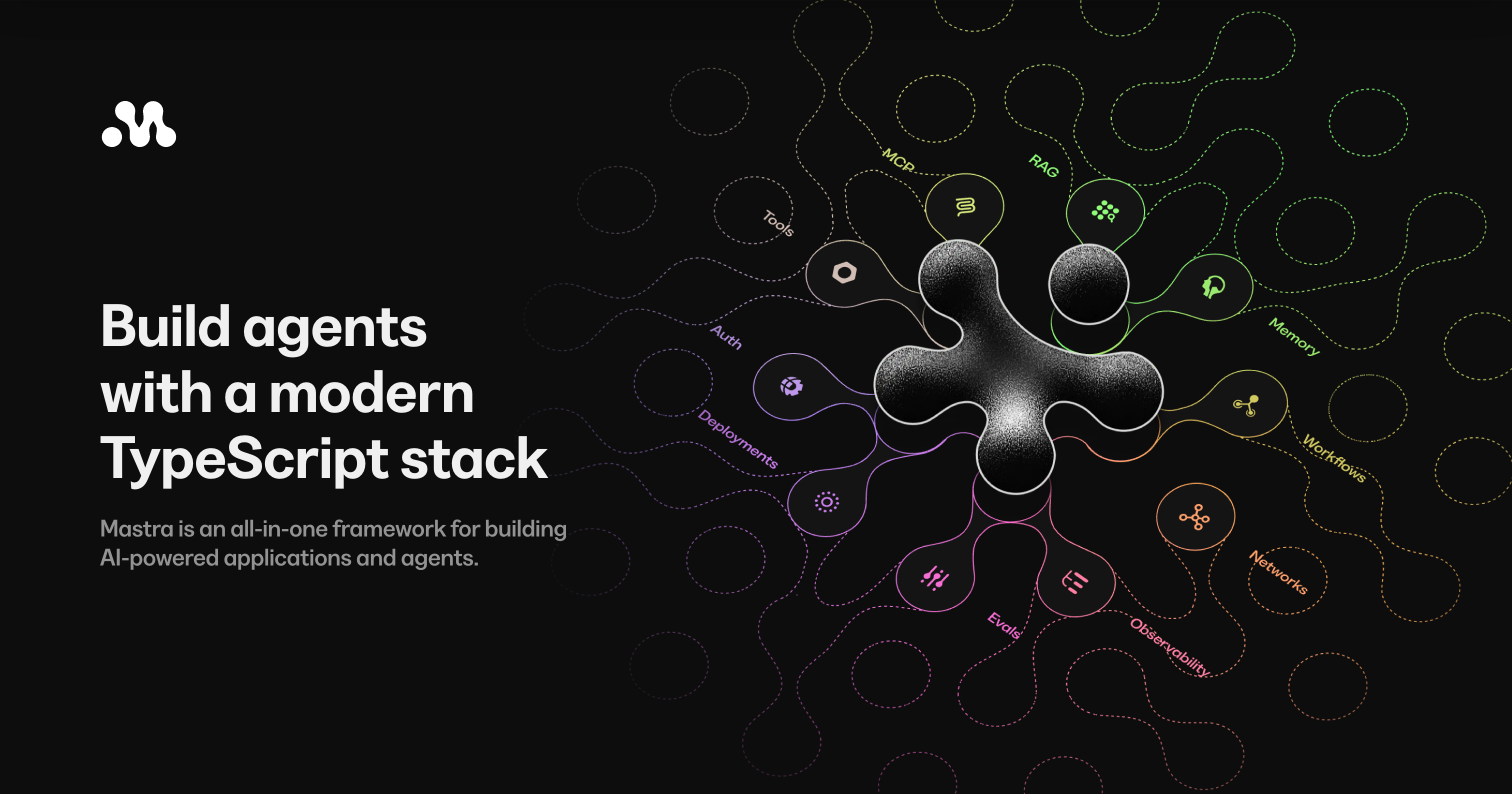
Build AI agents with a modern TypeScript stack
Published: 1/21/2026
Product Overview: The Modern Framework for Intelligent Applications
Mastra, hailing from the experienced team that brought us Gatsby, enters the burgeoning field of AI agent development with a bold promise: to provide a comprehensive, modern TypeScript framework for building sophisticated AI applications and agents. This isn't just another wrapper around an LLM API; Mastra is positioning itself as an end-to-end platform designed for developers seeking robustness, scalability, and enterprise-grade tooling in their generative AI projects.
At its core, Mastra simplifies the complexity inherent in building production-ready AI systems. It targets modern web developers, particularly those comfortable within the JavaScript/TypeScript ecosystem, who are looking to deploy intelligent agents that require more than simple prompt-response cycles. Whether you are envisioning complex automated workflows, customer service bots with long-term memory, or internal analysis tools, Mastra provides the architectural scaffolding needed to succeed.
The core value proposition of Mastra is its integrated nature. By bundling essential components like workflows, memory management, streaming capabilities, and robust evaluation tools directly into the framework, it eliminates the frustrating need to piece together disparate libraries for these critical functions.
Problem & Solution: Bridging the Gap Between Prototypes and Production
The primary challenge facing many AI developers today is the friction involved in moving from a successful local prototype to a reliable, scalable production system. Current solutions often require developers to manually stitch together memory layers, orchestrate multi-step reasoning (workflows), and implement complex tracing and evaluation systems—all outside the primary application logic. This leads to development bottlenecks, debugging nightmares, and inconsistent agent behavior in the wild.
Mastra solves this by offering a unified architecture built specifically for these advanced use cases. Where other solutions might treat features like state management or evaluation as afterthoughts, Mastra integrates them natively into the agent building process. By leveraging a modern TypeScript stack, it brings the benefits of strong typing, familiar tooling, and excellent performance—a significant advantage for professional software engineers accustomed to the rigorous standards of large-scale application development. This focus on developer experience within a robust system is the market gap Mastra aims to fill.
Key Features & Highlights: Tooling for Serious AI Development
The features highlighted by the Mastra team suggest a strong focus on operationalizing AI agents effectively. This framework is packed with elements crucial for building maintainable and trustworthy systems:
- Workflows and Memory: These are foundational. The ability to define complex, multi-step interactions (workflows) and give agents persistent, context-aware memory is crucial for any agent beyond simple querying.
- Streaming and Evals: Real-time feedback via streaming enhances user experience, while built-in evaluation (evals) tools ensure agents meet predefined quality metrics before deployment.
- Tracing: Critical for debugging complex agent decision paths. Tracing allows developers to visually inspect how an agent arrived at a specific output, making troubleshooting significantly faster.
- Studio Interface: Perhaps the most immediately engaging feature is Studio, an interactive UI designed specifically for development and testing. This visual sandbox allows developers to rapidly iterate, test edge cases, and monitor agent performance without constantly reverting to the command line.
The use of TypeScript throughout ensures that developers benefit from better code intelligence, fewer runtime errors, and cleaner interfaces when integrating these agents into larger applications.
Potential Drawbacks & Areas for Improvement
While the foundation laid by Mastra appears incredibly strong, especially given the pedigree of its creators, early-stage frameworks always face challenges. One immediate consideration for potential users will be community adoption and documentation depth. As a newer entry into the framework space, while the core tooling might be solid, extensive third-party libraries or a massive community troubleshooting base may take time to develop.
Furthermore, while the inclusion of a dedicated "Studio" UI is a massive win, it will be essential to ensure this interface scales effectively for complex, high-volume agent testing scenarios. For advanced users, ensuring granular control over underlying LLM parameters and cost optimization strategies within the framework might need explicit emphasis in future updates. Developers building for specific, highly niche models outside the mainstream (e.g., highly fine-tuned proprietary models) will need assurances that Mastra remains flexible enough to accommodate them without forcing users into a single vendor stack.
Bottom Line & Recommendation
Mastra is highly recommended for professional software development teams and experienced TypeScript developers who are moving past initial AI experimentation and need to build reliable, feature-rich AI agents for production environments. If your project demands sophisticated state management, complex orchestration (workflows), and rigorous testing capabilities, the integrated toolset offered by Mastra makes a compelling case for adoption.
For anyone looking to build scalable, debuggable, and maintainable AI applications using a modern stack, Mastra appears to be a game-changer. Give the npm create mastra@latest command a run—it looks like the future of serious AI agent development is written in TypeScript.
Featured AI Applications
Discover powerful tools to enhance your productivity
MindMax
New Way to Interact with AI
Beyond AI chat, transforming conversations into an infinite canvas. Combining brainstorming, mind mapping, critical and creative thinking tools to help you visualize ideas, solve problems efficiently, and accelerate learning.
AI Slides
AI Slides with Markdown
Revolutionary slide creation fusing AI intelligence with Markdown flexibility - edit anywhere, optimize anytime, iterate easily. Turn every idea into a professional presentation instantly.
AI Markdown Editor
Write Immediately
Extremely efficient writing experience: AI assistant, slash commands, minimalist interface. Open and write, easy writing. ✍️ Markdown simplicity + 🤖 AI power + ⚡ Slash commands = Perfect writing experience.
Chrome AI Extension
AI Assistant Anywhere
Transform your browsing experience with FunBlocks AI Assistant. Your intelligent companion supporting AI-driven reading, writing, brainstorming, and critical thinking across the web.