Open Wearables: The Open-Source Backbone for Next-Gen Health Tech
Open infrastructure for wearable-powered health products.
Published: 4/29/2026
Product Overview
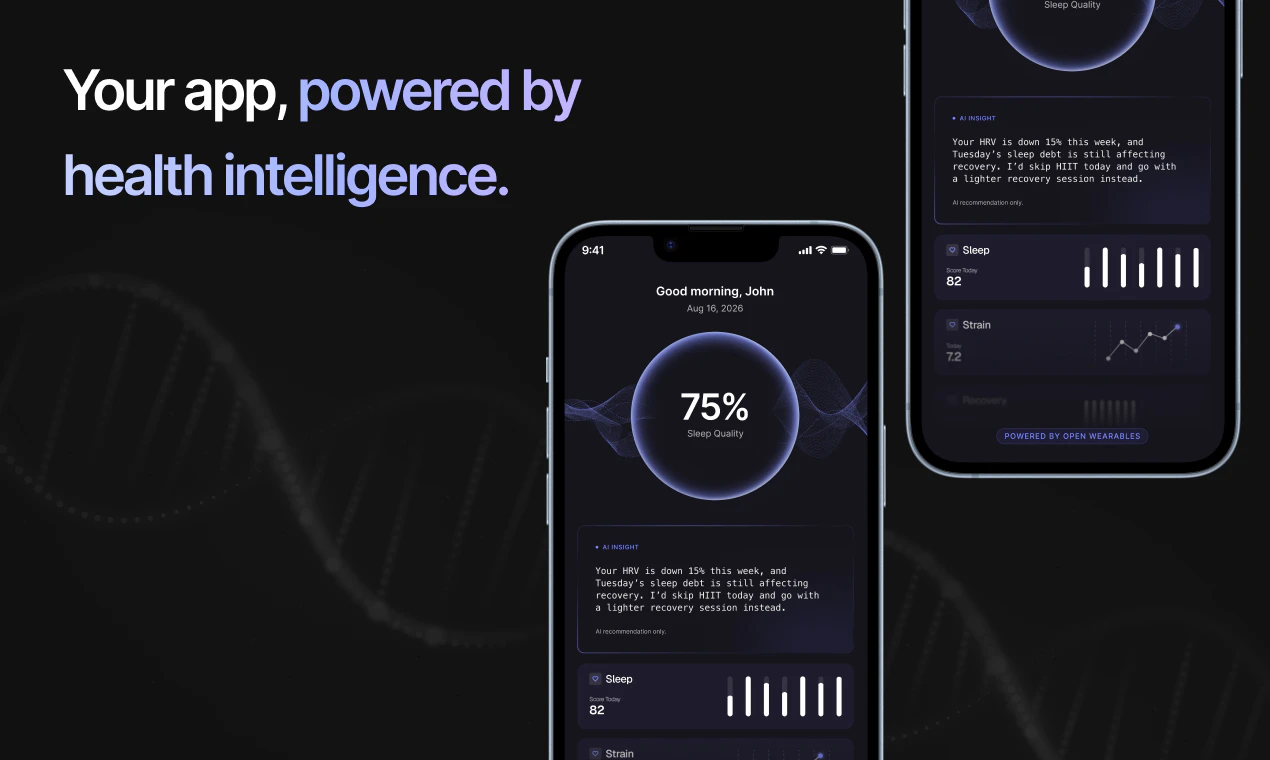
Open Wearables is a transformative platform designed to serve as the foundational infrastructure for developers building the next generation of wearable-powered health applications. At its core, the platform provides a unified API that bridges the gap between disparate wearable hardware and sophisticated health software. By abstracting the complexities of device-specific data formats, it allows creators to focus on building features rather than wrestling with hardware integrations.
The target audience for Open Wearables includes health-tech startups, individual developers, and research institutions looking to create personalized health tracking, predictive analytics, or longevity-focused applications. Whether you are building an AI-driven fitness coach or a remote patient monitoring tool, this platform offers the structured data and algorithmic support necessary to transform raw sensor input into meaningful health insights.
Problem & Solution
The current health-tech landscape is fragmented. Every wearable manufacturer—from Oura and Garmin to Apple and WHOOP—uses proprietary data silos. For a developer, building a product that supports multiple devices usually means maintaining dozens of separate integrations, normalizing messy raw data, and struggling with inconsistent API limitations. This high barrier to entry often kills innovative ideas before they leave the whiteboard.
Open Wearables solves this by acting as a universal translator. By providing a standardized API for every wearable, it eliminates the "integration fatigue" that hampers the industry. Furthermore, by being self-hosted and open-source under an MIT license, it offers a level of data sovereignty and cost-efficiency that closed-source competitors simply cannot match. It fills a critical market gap for developers who prioritize transparency and control over their infrastructure.
Key Features & Highlights
What truly sets Open Wearables apart is its commitment to "AI-ready" data. Beyond just collecting heart rate or step counts, the platform provides structured context that makes it incredibly easy for Large Language Models (LLMs) and other AI agents to interpret physiological trends.
Key features include:
- Universal API: A single integration point to pull data from virtually any popular wearable device.
- Open Health Algorithms: Access to transparent, customizable scoring logic, allowing developers to fine-tune how health metrics are calculated rather than relying on "black box" proprietary scores.
- Self-Hosted Architecture: Total control over data storage and privacy, making it an excellent choice for healthcare applications that must comply with strict data residency regulations.
- Structured Data Schema: Data is cleaned and formatted in a way that allows AI models to reason over health trends without needing significant pre-processing.
The developer experience (DX) is clearly a priority here. By providing a modular architecture, developers can pick and choose the specific components they need, avoiding the "bloat" often found in massive, all-in-one health-tracking SDKs.
Potential Drawbacks & Areas for Improvement
While the technical promise is immense, Open Wearables faces the challenge of ecosystem adoption. Because the platform relies on external device APIs, it is inherently dependent on the stability and access policies of wearable manufacturers. If a major brand decides to restrict its API, the platform’s effectiveness for that specific device could be temporarily compromised.
Additionally, as an open-source project, the burden of maintenance falls on the community and the core contributors. For small startups, the lack of "enterprise-grade" managed support might be a deterrent compared to paid SaaS alternatives like Terra or exist.io. Adding more comprehensive documentation for custom integration deployment and potentially offering a managed "cloud" tier would significantly lower the barrier for non-technical founders looking to leverage this infrastructure.
Bottom Line & Recommendation
Open Wearables is a must-try for any developer or team currently building in the health-tech or longevity space. If you are tired of struggling with fragmented wearable APIs and want to retain full control over your data stack, this is currently the most compelling open-source solution on the market. By democratizing access to complex health data, Open Wearables isn't just a tool; it’s an essential accelerator for the future of personalized digital health. Highly recommended for those who value transparency, sovereignty, and efficient development cycles.
Featured AI Applications
Discover powerful tools to enhance your productivity
MindMax
New Way to Interact with AI
Beyond AI chat, transforming conversations into an infinite canvas. Combining brainstorming, mind mapping, critical and creative thinking tools to help you visualize ideas, solve problems efficiently, and accelerate learning.
AI Slides
AI Slides with Markdown
Revolutionary slide creation fusing AI intelligence with Markdown flexibility - edit anywhere, optimize anytime, iterate easily. Turn every idea into a professional presentation instantly.
AI Markdown Editor
Write Immediately
Extremely efficient writing experience: AI assistant, slash commands, minimalist interface. Open and write, easy writing. ✍️ Markdown simplicity + 🤖 AI power + ⚡ Slash commands = Perfect writing experience.
Chrome AI Extension
AI Assistant Anywhere
Transform your browsing experience with FunBlocks AI Assistant. Your intelligent companion supporting AI-driven reading, writing, brainstorming, and critical thinking across the web.