OpenUI Review: Finally, Interactive Generative UIs That Work with Any Model
The open standard for Generative UI
Published: 3/11/2026
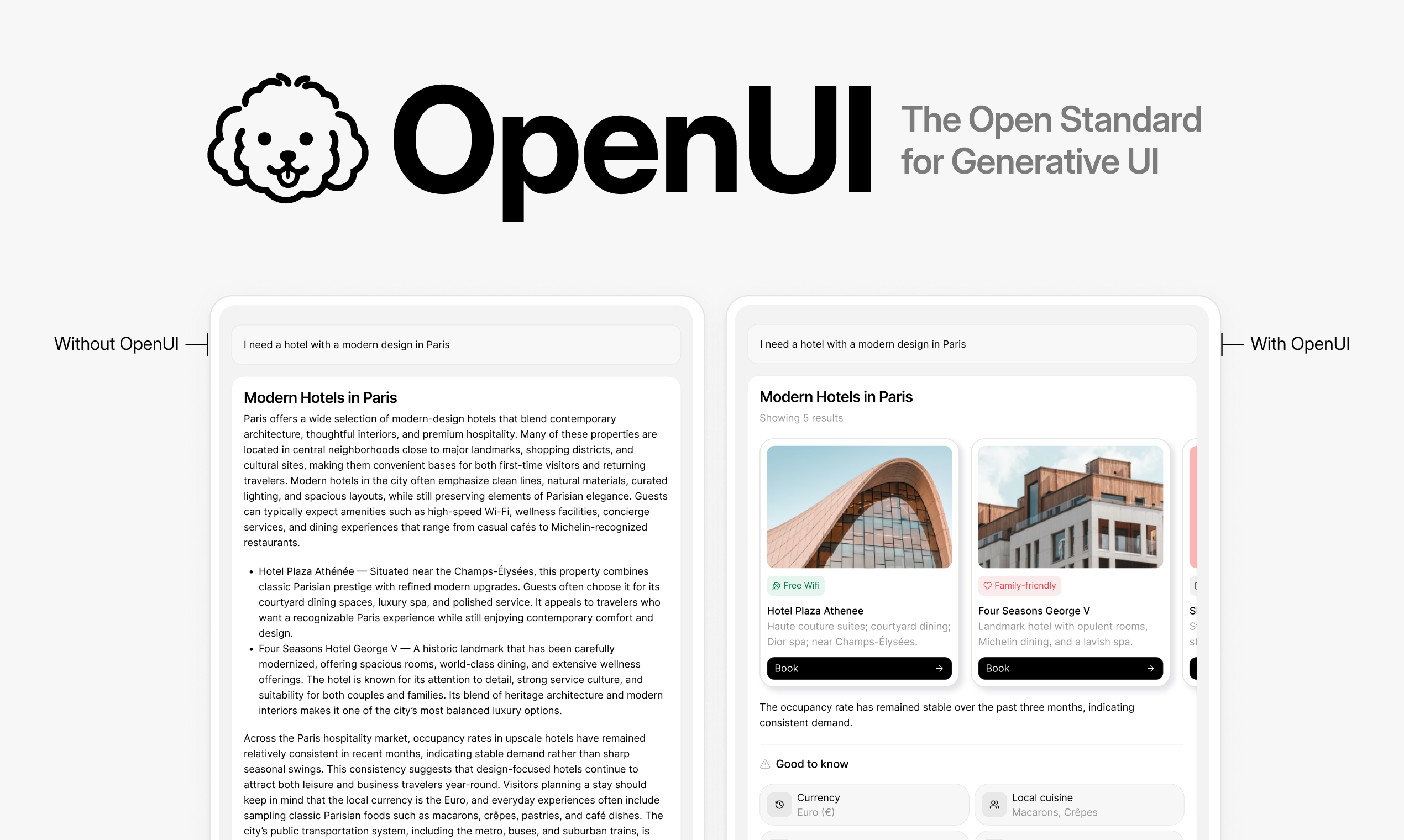
The landscape of generative AI applications is rapidly maturing, moving beyond simple text dumps to integrated workflows. However, one significant bottleneck remains: the output format. Most Large Language Models (LLMs) default to verbose, unformatted text, forcing developers to spend significant time parsing responses to build usable interfaces. Enter OpenUI, positioning itself as "The open standard for Generative UI." This ambitious project aims to democratize interactive AI responses, ensuring that your AI assistants deliver tangible components—cards, tables, forms, and charts—rather than walls of text.
Product Overview: Bridging the Gap Between AI Logic and User Experience
OpenUI tackles the friction point between backend AI intelligence and frontend user interaction. Instead of simply receiving a raw string response from GPT-4 or Claude, OpenUI enables LLMs to stream back structured UI components. This transforms passive AI output into active, dynamic user experiences immediately usable within an application.
The core value proposition is platform agnosticism. OpenUI isn't tied to a specific model provider; it functions as a universal translator layer. It is explicitly designed to integrate seamlessly with popular development frameworks like ai-sdk and Google's ADK, making it highly attractive for full-stack developers and AI startups looking to future-proof their frontends against shifting LLM dominance.
Problem & Solution: Moving Beyond Plain Text Responses
The pervasive problem OpenUI addresses is the "text-only trap." When an LLM is asked to perform a task—like retrieving customer data, scheduling an appointment, or visualizing a metric—it often returns instructions or raw data embedded in markdown. Developers must then write custom parsing logic for every unique response structure across every model they support. This is brittle, time-consuming, and inherently limits the richness of the AI interaction.
OpenUI solves this by standardizing the output format for common UI patterns. By adopting an open standard, developers can instruct the model to return a pre-defined Card component payload, a fully interactive Table, or even a sophisticated Chart. The framework handles the rendering, ensuring consistency, efficiency, and a dramatic reduction in boilerplate code required to turn raw AI output into a functioning interface. This adherence to an open standard is key, preventing vendor lock-in common in proprietary AI tooling.
Key Features & Highlights: Streaming Native and Model Agnostic Power
The architecture of OpenUI appears optimized for modern, responsive applications. Several features stand out for professional developers building high-performance AI tools:
- Streaming Native: Crucial for perceived performance, OpenUI supports streaming token-by-token responses. This means users see the UI component assemble itself in real-time, mimicking the fluidity of modern chatbot interfaces but delivering structure instead of just text.
- Component Library: The ability to output structured components like forms, interactive tables, and charts means generative AI can move from being an answer engine to an action engine. Imagine an AI that doesn't just describe a budget but streams a fully populated, editable budget spreadsheet directly into your app.
- Model and Framework Compatibility: The explicit support for major players like GPT, Claude, and integration points like
ai-sdkdemonstrates a commitment to broad compatibility, making adoption easier for existing generative AI stacks. This flexibility is a massive selling point for startups balancing multiple LLM evaluation paths. - Token Efficiency: By standardizing output, the models are likely trained or prompted to return concise, structured data payloads, which contributes to lower operational costs compared to verbose textual descriptions.
Potential Drawbacks & Areas for Improvement
While OpenUI presents a powerful vision, early adoption always requires considering limitations. Because it relies on the LLM correctly formatting its output to the OpenUI schema, the reliability hinges significantly on prompt engineering and the model's adherence to those instructions. If a model consistently drifts outside the required JSON/structure, the rendering layer will fail gracefully, but the user experience degrades.
For enhancement, I would strongly suggest expanding the readily available, themeable component library. Developers will want to ensure the default OpenUI components can easily adopt their application’s existing design system (e.g., Tailwind, Material UI, Chakra UI). Furthermore, providing robust documentation on how to train or fine-tune models (if necessary) to reliably produce these structured outputs for niche use cases would significantly lower the barrier to entry for complex applications.
Bottom Line & Recommendation
OpenUI is an essential toolkit for any team building sophisticated, production-ready generative AI applications. If your current AI workflow is bogged down by parsing text output to render interfaces, OpenUI offers a standardized, high-performance solution. It is highly recommended for AI application builders, frontend engineers integrating LLMs, and startups prioritizing rich, interactive user experiences over simple Q&A bots. OpenUI is poised to become the foundational layer that makes generative UIs truly ubiquitous across the modern web stack.
Featured AI Applications
Discover powerful tools to enhance your productivity
MindMax
New Way to Interact with AI
Beyond AI chat, transforming conversations into an infinite canvas. Combining brainstorming, mind mapping, critical and creative thinking tools to help you visualize ideas, solve problems efficiently, and accelerate learning.
AI Slides
AI Slides with Markdown
Revolutionary slide creation fusing AI intelligence with Markdown flexibility - edit anywhere, optimize anytime, iterate easily. Turn every idea into a professional presentation instantly.
AI Markdown Editor
Write Immediately
Extremely efficient writing experience: AI assistant, slash commands, minimalist interface. Open and write, easy writing. ✍️ Markdown simplicity + 🤖 AI power + ⚡ Slash commands = Perfect writing experience.
Chrome AI Extension
AI Assistant Anywhere
Transform your browsing experience with FunBlocks AI Assistant. Your intelligent companion supporting AI-driven reading, writing, brainstorming, and critical thinking across the web.