ShapedQL Review: The SQL Engine Redefining Real-Time Relevance for Search and AI Agents
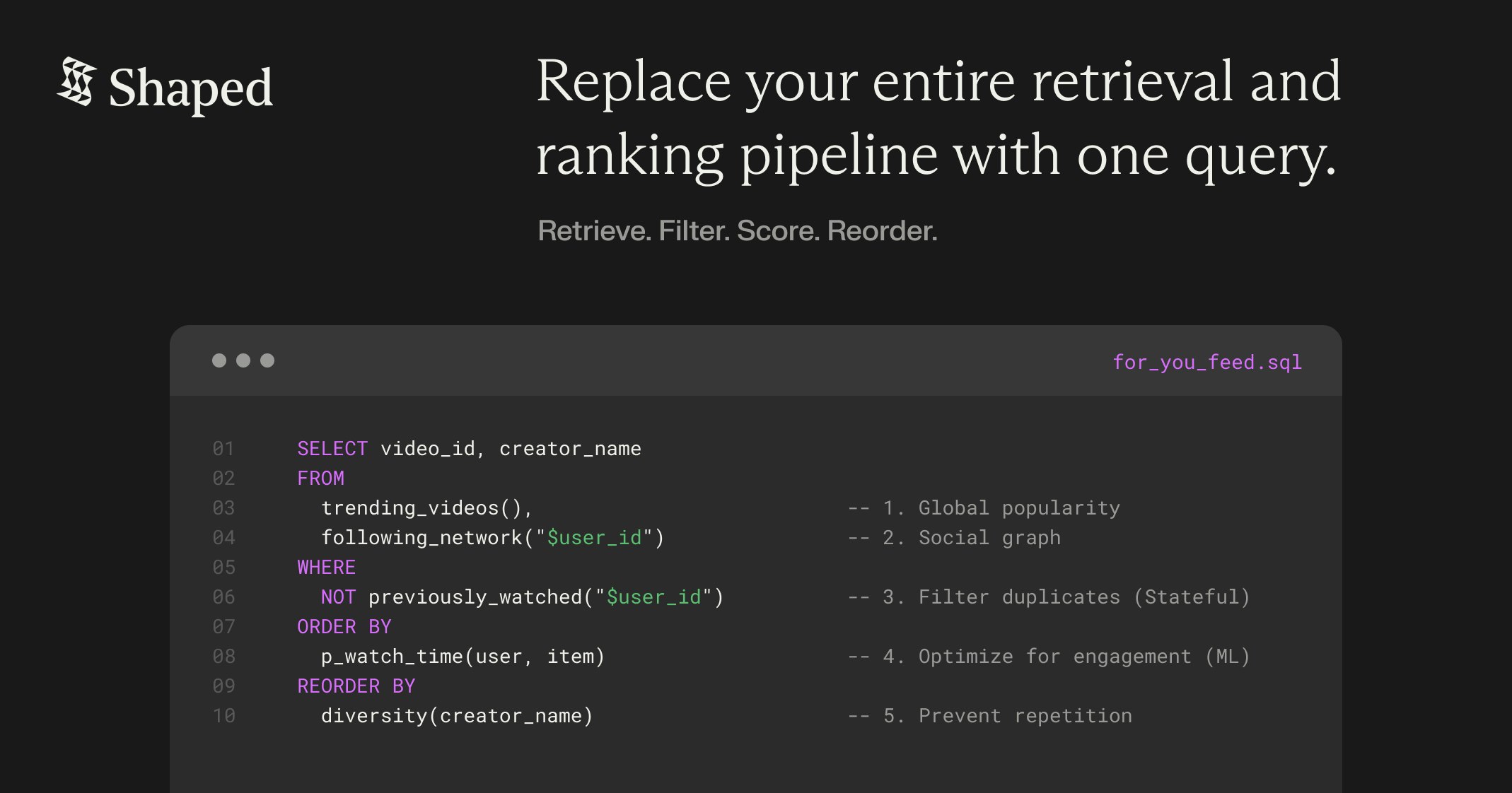
The SQL engine for search, feeds, and AI agents
Published: 1/27/2026
ShapedQL is launching into the highly competitive vector database and real-time data processing space with a bold promise: to replace complex infrastructure glue with elegant, powerful SQL. Taglined as "The SQL engine for search, feeds, and AI agents," ShapedQL aims to dramatically simplify the development lifecycle for building personalized user experiences that require low-latency ranking and relevance scoring. This review dives deep into how this innovative tool stacks up against current industry standards for powering features like dynamic "For You" recommendation feeds and advanced Retrieval-Augmented Generation (RAG) systems.
Product Overview: Bringing SQL Power to Real-Time Ranking
ShapedQL positions itself as the essential middleware layer sitting between raw data and sophisticated retrieval logic. Instead of requiring developers to manually orchestrate separate services—like using Pinecone for vector storage, Redis for caching, and custom Python scripts for complex ranking pipelines—ShapedQL consolidates these capabilities into a single, declarative language: SQL.
The core value proposition here is massive developer velocity and infrastructure simplification. ShapedQL allows teams to define intricate, real-time ranking algorithms using just a few lines of familiar SQL. This is crucial for any modern application demanding high relevance, whether that means surfacing the most timely news articles in a feed, optimizing e-commerce search results based on immediate user actions, or ensuring an AI agent accesses the most contextually relevant memory chunks for an RAG query. It’s an engine built not just for retrieval, but for decision-making based on data context.
Problem & Solution: Decoupling Relevance from Infrastructure
The critical problem ShapedQL addresses is the "glue code fatigue" prevalent in building modern recommendation and search systems. Currently, developers spend significant time stitching together disparate specialized tools: vector databases handle similarity search, caching layers manage hot data, and custom code implements the business logic for filtering, scoring, and reordering—often leading to brittle, slow, and expensive infrastructure stacks.
ShapedQL solves this by compiling standard SQL queries into optimized, real-time ranking pipelines. This abstraction shifts the focus from infrastructure management back to defining desired outcomes. If you can express the ranking logic in SQL (i.e., "Filter by category X, score by recency, boost based on recent click-through rate"), ShapedQL handles the complex, low-level execution across different data modalities—including native support for multi-modal embeddings—automating the MLOps required to keep the models fresh and the rankings relevant. It fills the market gap by offering a declarative, unified interface where existing database experts (SQL users) can immediately contribute to building cutting-edge relevance features.
Key Features & Highlights: Declarative Power and Multi-Modality
ShapedQL’s strength lies in its ability to embed complex operational logic directly within the query layer. This moves beyond simple vector distance lookups into true relevance engineering.
Key highlights include:
- SQL-Powered Ranking: Expressing complex logic like filtering, scoring, and reordering results based on live user behavior using familiar SQL syntax.
- Real-Time Decisioning: The ability to leverage live data streams for immediate result adjustments, far surpassing static indexing approaches.
- Native Multi-Modal Embeddings: Support for handling and integrating various data types (text, image, etc.) directly within the engine, which is a significant advantage for modern RAG and content discovery.
- Automated MLOps: Abstracting away the complexities of model retraining and deployment necessary to maintain ranking accuracy over time.
The shift from imperative code (telling the system how to execute) to declarative SQL (telling the system what the result should look like) is a game-changer for developer experience, potentially reducing thousands of lines of custom infrastructure code down to dozens of focused SQL statements.
Potential Drawbacks & Areas for Improvement
While the promise of ShapedQL is compelling, new infrastructure tools inherently carry adoption friction and scaling questions. A key area for improvement will be transparency and observability into the generated pipelines. When a complex SQL query produces a result that seems suboptimal, developers need detailed insight into how the engine interpreted the query and executed the multi-stage ranking process. Documentation on debugging and visualizing these compiled pipelines will be crucial for enterprise adoption.
Furthermore, the success of ShapedQL relies heavily on how well it integrates with existing data stores and embedding models already in use. While it touts abstraction, providing robust, well-documented connectors for major vector databases (even if it aims to replace them) or popular open-source embedding providers will ease migration paths for early adopters. Lastly, performance benchmarks against highly optimized, hand-tuned systems (like those built with pure Rust or Go) will be necessary to prove that the SQL abstraction layer doesn't introduce unacceptable latency ceilings for ultra-high-throughput use cases.
Bottom Line & Recommendation
ShapedQL is a powerful, ambitious product targeting developers and engineers responsible for application relevance—specifically those working on recommendation engines, advanced search interfaces, and sophisticated RAG memory systems. If your team is currently bogged down managing the complexity of Pinecone, Redis, and custom Python processing to achieve real-time personalization, ShapedQL is a must-try. It offers a compelling pathway to drastically simplify your stack while potentially increasing the sophistication of your ranking capabilities. This product signals a significant shift toward declarative relevance engineering, making it an essential tool to watch in the AI infrastructure landscape.
Featured AI Applications
Discover powerful tools to enhance your productivity
MindMax
New Way to Interact with AI
Beyond AI chat, transforming conversations into an infinite canvas. Combining brainstorming, mind mapping, critical and creative thinking tools to help you visualize ideas, solve problems efficiently, and accelerate learning.
AI Slides
AI Slides with Markdown
Revolutionary slide creation fusing AI intelligence with Markdown flexibility - edit anywhere, optimize anytime, iterate easily. Turn every idea into a professional presentation instantly.
AI Markdown Editor
Write Immediately
Extremely efficient writing experience: AI assistant, slash commands, minimalist interface. Open and write, easy writing. ✍️ Markdown simplicity + 🤖 AI power + ⚡ Slash commands = Perfect writing experience.
Chrome AI Extension
AI Assistant Anywhere
Transform your browsing experience with FunBlocks AI Assistant. Your intelligent companion supporting AI-driven reading, writing, brainstorming, and critical thinking across the web.