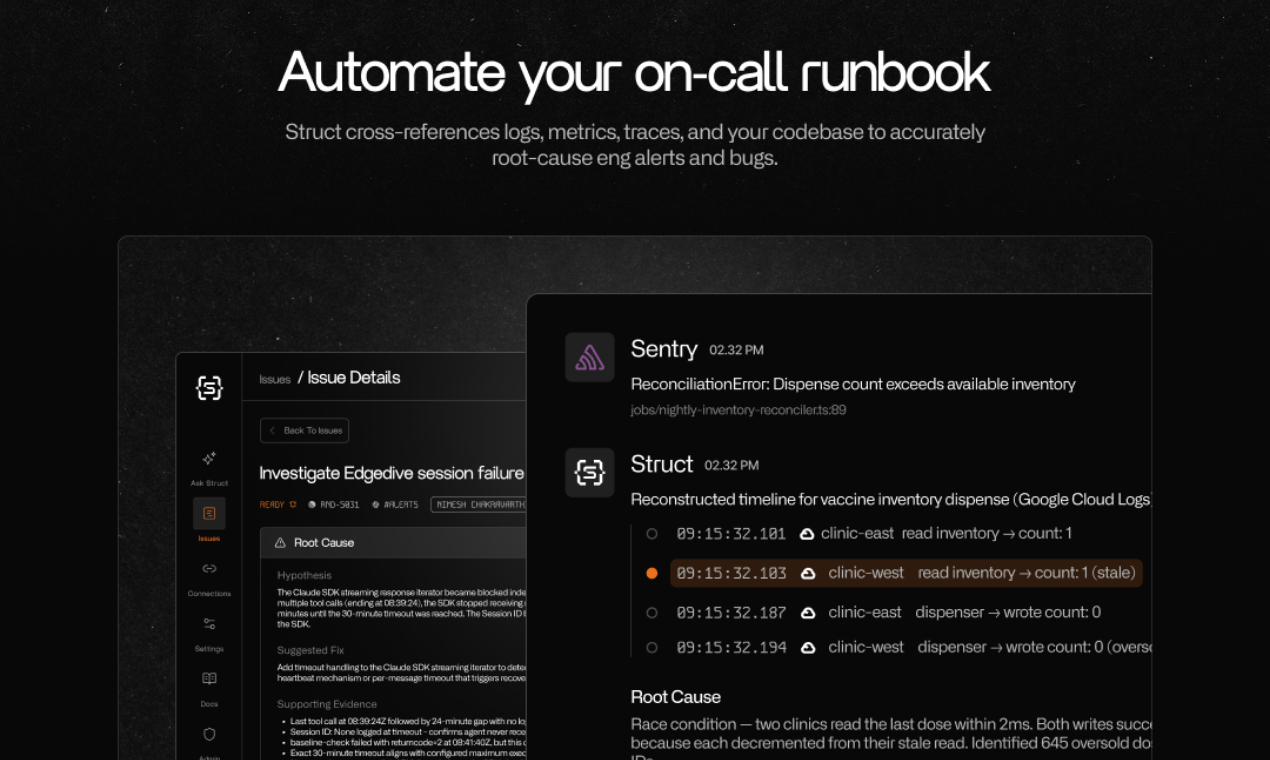
Struct: The AI Agent Revolutionizing Engineering Alert Root Cause Analysis
AI agent that root-causes engineering alerts
Published: 3/14/2026
Product Overview: Diagnosing Incidents at the Speed of AI
Struct arrives in the increasingly critical domain of Site Reliability Engineering (SRE) and DevOps tooling, positioned not just as another monitoring dashboard, but as an active diagnostic agent. Taglined as the "AI agent that root-causes engineering alerts," Struct aims to drastically compress the Mean Time To Resolution (MTTR) for system incidents. It accomplishes this by synthesizing complex, disparate data sources—logs, metrics, traces, and even relevant snippets of application code—into a cohesive, actionable narrative detailing the source of a failure.
This tool is squarely aimed at engineering teams, DevOps practitioners, SREs, and backend developers who spend countless hours context-switching between monitoring tools (like Datadog or Prometheus) and incident response platforms (like PagerDuty or Opsgenie) just to find the needle in the haystack that caused the alert. Struct’s core value proposition is shifting the engineer’s focus from investigation to remediation. By offering a composable and customizable system that integrates seamlessly into existing workflows, Struct promises significant productivity gains during high-stress incident scenarios.
Problem & Solution: Cutting Through Observability Noise
The perennial problem plaguing modern infrastructure is data overload. When an alert fires—a spike in latency or an increase in error rates—engineers are immediately confronted with gigabytes of log files, noisy metric graphs, and scattered tracing data. The bottleneck isn't collecting data; it’s interpreting it quickly enough under pressure. This manual correlation process is time-consuming, error-prone, and directly impacts user experience and service availability.
Struct solves this by deploying a sophisticated AI agent specifically trained on the context of engineering artifacts. Unlike passive monitoring tools that simply flag anomalies, Struct actively performs the root cause analysis. It uses its advanced capabilities to connect the dots—for instance, correlating a sudden spike in 500 errors in the logs with a specific commit recently deployed (pulled from code context) and the accompanying sharp dip in throughput shown in the metrics. This capability fills a significant market gap for automated, cross-domain incident diagnosis beyond simple threshold alerting.
Key Features & Highlights: Composable and Context-Aware Diagnosis
The standout feature of Struct is its ability to ingest and correlate data across the entire observability stack. It’s not siloed into one data type; it actively weaves together the narrative thread linking disparate signals.
Key highlights of the Struct platform include:
- Multi-Source Correlation: Seamlessly ingests and cross-references logs, metrics, traces, and code context.
- Rapid Deployment: Emphasizing speed, Struct is designed to deploy quickly, integrating into current DevOps workflows rather than forcing a lengthy overhaul.
- Composability: The system is customizable, suggesting that engineering teams can tailor the AI’s focus and integration points to their specific application architecture.
- Actionable Output: Instead of raw data dumps, Struct aims to deliver a clear, prioritized explanation of the root cause, accelerating the path to writing the fix.
The user experience, as implied by the description, seems focused on minimizing cognitive load during an incident. When an alert hits your system, Struct delivers a concise diagnosis, allowing engineers to immediately focus on the required code change or configuration adjustment, rather than spending the first 30 minutes building that context.
Potential Drawbacks & Areas for Improvement
While the promise of automated root-cause analysis is compelling, any AI-driven diagnostic tool faces inherent challenges, particularly regarding transparency and trust. A key area for improvement for Struct will be ensuring the explainability of its AI findings. If an engineer sees Struct diagnosing a root cause, they need immediate confidence that the analysis is sound, especially when making critical production changes.
Suggestions for enhancement would center on:
- Confidence Scoring: Providing a transparent confidence score or justification layer alongside the root cause diagnosis.
- Proactive Learning Loops: Enabling engineers to easily mark an analysis as correct or incorrect, feeding that feedback directly into the model to improve future correlation accuracy for that specific stack configuration.
- Integration Depth: While it works with existing workflows, offering deeper, one-click integrations with specific ticketing systems (e.g., automatically generating a Jira ticket pre-populated with the fix hypothesis) would enhance workflow fidelity.
Bottom Line & Recommendation
Struct is a powerful contender in the rapidly evolving field of AI-assisted incident management. For any engineering team struggling with alert fatigue or suffering from high MTTR due to the complexity of diagnosing microservice-related failures, Struct is an essential tool to evaluate. It addresses a genuine pain point by moving beyond simple anomaly detection into true automated diagnostics. If your team prioritizes speed and efficiency during incidents and is ready to leverage AI to synthesize vast amounts of observability data, Struct promises to be a transformative addition to your DevOps toolkit. Highly recommended for SRE and platform engineering teams looking to cut debugging time drastically.
Featured AI Applications
Discover powerful tools to enhance your productivity
MindMax
New Way to Interact with AI
Beyond AI chat, transforming conversations into an infinite canvas. Combining brainstorming, mind mapping, critical and creative thinking tools to help you visualize ideas, solve problems efficiently, and accelerate learning.
AI Slides
AI Slides with Markdown
Revolutionary slide creation fusing AI intelligence with Markdown flexibility - edit anywhere, optimize anytime, iterate easily. Turn every idea into a professional presentation instantly.
AI Markdown Editor
Write Immediately
Extremely efficient writing experience: AI assistant, slash commands, minimalist interface. Open and write, easy writing. ✍️ Markdown simplicity + 🤖 AI power + ⚡ Slash commands = Perfect writing experience.
Chrome AI Extension
AI Assistant Anywhere
Transform your browsing experience with FunBlocks AI Assistant. Your intelligent companion supporting AI-driven reading, writing, brainstorming, and critical thinking across the web.