This is how Munger would use AI | FunBlocks AIFlow Lattice of Mental Models Node
You've been there. You type a hard question into ChatGPT — why are my users churning? why is growth stalling? what am I missing? — and it comes back with a clean, confident answer.
You read it. It sounds reasonable. You try it.
Nothing changes.
The problem isn't that the AI was wrong. The problem is that it was only partially right — because it looked at your situation from a single angle, synthesized into one tidy voice. And complex, real-world problems don't live in one dimension.
They live at the intersection of systems, psychology, economics, and time.
That's exactly the gap that FunBlocks AIFlow's new Lattice of Mental Models node is built to close.
The Man Who Carried a Whole Toolbox
Charlie Munger — Warren Buffett's longtime partner and one of the greatest investors in history — had a philosophy that set him apart from almost every other thinker in business.
He called it the Latticework of Mental Models.
The idea was deceptively simple: every academic field — physics, psychology, biology, economics, history — has spent decades developing powerful frameworks for understanding the world. These aren't just abstract theories. They're battle-tested lenses for cutting through complexity.
Most people only know the models from their own field. A marketer thinks in funnels. An engineer thinks in systems. A therapist thinks in behavior loops.
Munger knew 80 to 100 models from across all disciplines — and he used them simultaneously.
"To the man with a hammer, everything looks like a nail. But Munger carried a whole toolbox."
The result? He spotted things that other investors couldn't see, because he was always looking from multiple angles at once. When several different models all pointed at the same problem, he knew it was real. When two models seemed to contradict each other, he knew that tension was where the most important trade-off was hiding.
This isn't just a smart investing philosophy. It's one of the most powerful thinking approaches ever documented — and until now, no AI tool has actually operationalized it.
Why Single-Perspective AI Keeps Failing You
Here's something uncomfortable to sit with: most AI tools — including the best ones — are architecturally designed to converge on a single answer.
They synthesize everything they know into one coherent response. That coherence feels like clarity. But for complex problems, it's actually a loss of information.
Real problems have multiple causes. Multiple stakeholders. Multiple timescales. Multiple dynamics happening simultaneously. When you ask an AI for "the answer," you're forcing a multidimensional problem into a single dimension.
Think about some genuinely hard questions:
- Why do our SaaS users cancel after month three?
- Should we expand into this new market right now?
- Why does our team keep underperforming despite the right incentives?
These aren't questions with one answer. They're questions with several partially-true answers that tension against each other. The right move only becomes clear when you can see all of them at once.
That's what Munger understood. And that's what AIFlow's new feature finally makes possible.
Introducing: Lattice of Mental Models in FunBlocks AIFlow
The new Lattice of Mental Models node in FunBlocks AIFlow takes your problem — any complex, messy, real-world problem — and applies six to eight of history's most powerful mental models simultaneously.
Not sequentially. Not superficially. Simultaneously, with genuine cross-disciplinary depth.
Here's what that looks like in practice.
🎥 Watch the full demo:
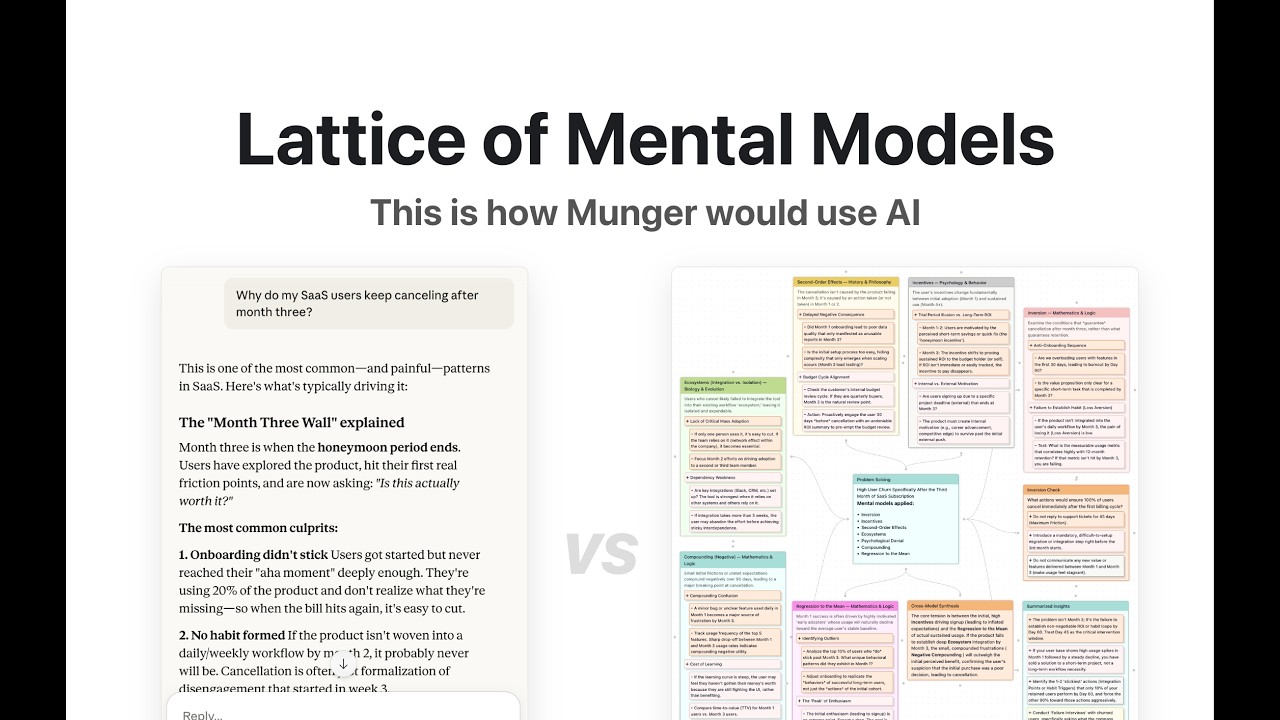
A Real Example: SaaS Churn After Month Three
Let's say you're a SaaS founder. You've noticed users consistently cancel around the 90-day mark. You've asked your AI tool. It said something like: "Focus on onboarding and improve the in-app experience."
Useful? Maybe. Sufficient? Definitely not.
Here's what happens when AIFlow's Lattice node analyzes the same problem:
Systems Thinking Where is the feedback loop that's actively making things worse? Maybe your onboarding flow creates an illusion of progress without delivering real value — and that gap compounds over 90 days until users hit a wall.
Behavioral Psychology At exactly what cognitive moment do users decide it's not worth staying? Loss aversion research tells us that people don't leave when they're bored — they leave when they feel like they've already lost something by continuing. If your product hasn't created a sense of loss by day 30, you're already in trouble.
Evolutionary Biology Has your product stopped adapting to the actual patterns of how your users behave in the wild? Features built for hypothetical users don't survive contact with real ones.
Economics What's the full cost — not just money, but time, cognitive load, switching cost — that users are actually paying to stay subscribed? You might be underestimating this by a factor of three.
Game Theory What competing alternatives are implicitly raising the bar each month? Your product isn't being evaluated in isolation. It's in a constant silent comparison to every other way the user could spend that budget and that hour.
Information Theory Are users getting a clear signal that the product is working? Or is the signal-to-noise ratio so high that the value gets lost in complexity?
Each of these reveals something the others wouldn't catch. And here's where it gets powerful: when multiple models converge on the same issue, that's your highest-priority action. If Systems Thinking and Behavioral Psychology and Economics all point to the same 30-day window — you know exactly where to focus.
And when two models contradict? That's your most important strategic trade-off, right there on the page.
The Four Design Principles Behind the Feature
AIFlow's Lattice node isn't just "ask six different prompts." It was built around four hard requirements.
1. Inversion First
Before asking how to succeed, ask what would guarantee failure.
This was one of Munger's favorite techniques — and it's built into every AIFlow analysis. Inversion surfaces the hidden traps and blind spots before you commit to a direction. It's the difference between an analysis that feels good and one that actually protects you.
2. Genuine Cross-Disciplinary Thinking
Not relabeling the same idea with different headers. Each model has to reveal a genuinely different dimension of your problem. If two models are saying essentially the same thing from different angles, one of them doesn't make the cut.
3. Cross-Model Synthesis
This is where the real insight lives. The individual models are inputs — the synthesis is the output. Where do they agree? Where do they conflict? What does the pattern of their disagreements tell you about your actual trade-off?
A good synthesis doesn't average the models. It interrogates the tensions between them.
4. Insights Worth Acting On
There's a big difference between:
"Improving user experience is important for retention."
And:
"Your retention problem isn't a missing feature. It's that users feel no psychological anchor in the first 72 hours. There's no loss aversion mechanism keeping them. Fix the loss architecture before you build anything else."
The second is actionable. The first is a platitude wearing an insight's clothes. AIFlow is designed to produce the second kind.
Who This Is For
The Lattice of Mental Models feature was built for people dealing with problems that are genuinely hard — not hard because they need more data, but hard because they involve:
- Competing variables pulling in different directions
- Human behavior that doesn't follow logical models
- Long-tail consequences that ripple forward in time
- High stakes where the cost of being wrong is real
In practice, that means:
Founders trying to diagnose why growth has stalled, why a product isn't clicking, or whether a pivot makes sense.
Investors evaluating opportunities where the narrative is compelling but the dynamics are unclear.
Strategists and consultants who need to give clients recommendations that hold up under scrutiny from multiple directions.
Researchers working on questions where the literature from one field keeps missing something that another field would immediately recognize.
Anyone facing a decision that's messy, high-stakes, and genuinely uncertain.
If your problem has a simple answer, just Google it. Seriously. AIFlow is overkill for simple problems.
But if it involves the intersection of systems, people, incentives, and time — that's exactly where the Lattice of Mental Models operates.
What This Changes About How You Use AI
Most people have learned to use AI as a faster way to get to one answer. That's useful, but it keeps the bottleneck in the same place: your problem is still being looked at through a single lens.
The shift that the Lattice approach enables is different in kind, not just degree. It's the difference between:
- Asking an expert → Getting their expert opinion
- Convening a room of experts from different fields → Getting a debate where the tensions produce the real insight
Munger spent decades building his latticework manually. He read voraciously across fields. He built his own internal library of models and practiced applying them until it became instinctive.
Most people don't have decades. Most problems don't wait.
AIFlow gives you the output of that kind of thinking — applied to your specific problem — in minutes.
Try It Yourself
The best way to understand what this does is to put a real problem into it.
Not a toy example. Your actual hard problem. The one you've been turning over. The one where you have a working hypothesis but you're not quite sure you're seeing it clearly.
Type it in. Watch six to eight of the world's most powerful thinking frameworks converge on it simultaneously. See what you've been missing.
No setup required. The Lattice of Mental Models node is available in the free tier.
Further Reading
If the Latticework of Mental Models concept is new to you, here's where to go deeper:
- Poor Charlie's Almanack — The closest thing to a Munger reader. Dense, brilliant, worth every page.
- The Great Mental Models series by Shane Parrish (Farnam Street) — Probably the best modern treatment of the individual models.
- Thinking in Systems by Donella Meadows — The definitive introduction to Systems Thinking as a mental model.
- Influence by Robert Cialdini — The behavioral psychology models you'll use constantly once you know them.
The models Munger used aren't secret. They're learnable. The challenge has always been applying them simultaneously, under pressure, to your actual problem.
That's the problem AIFlow is now built to solve.
FunBlocks AIFlow is an AI-powered visual thinking and analysis tool. The Lattice of Mental Models node is part of the AIFlow node library, designed to apply cross-disciplinary mental model frameworks to complex real-world problems.