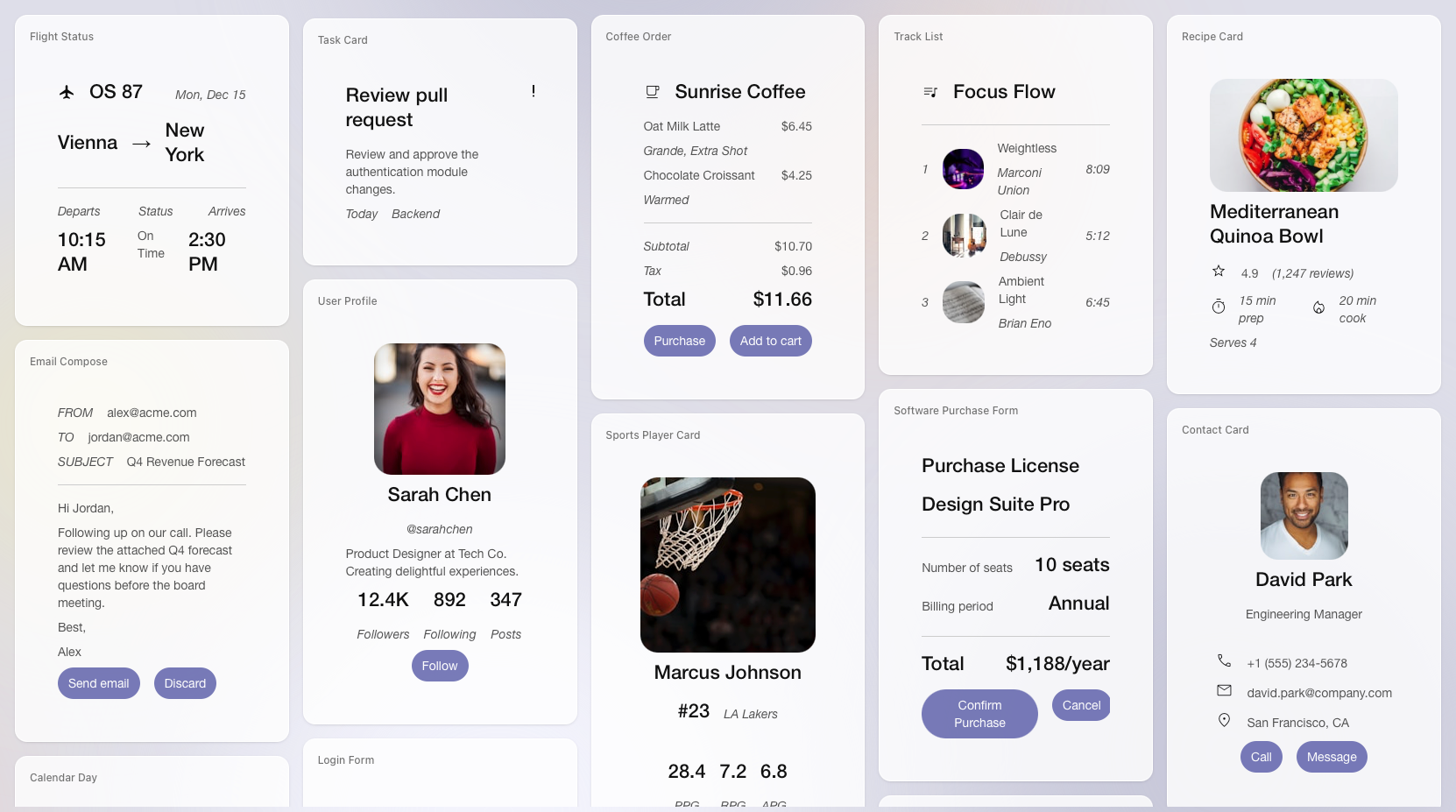
A2UI Review: The Protocol Revolutionizing How AI Builds Interactive Application Interfaces
A safe way for AI to build UIs your app can render
发布时间: 12/24/2025
Product Overview: Declarative UI Generation for the AI Age
A2UI, an open protocol backed by Google, stands at a crucial intersection of artificial intelligence and front-end development. In an era where Large Language Models (LLMs) are increasingly capable of complex reasoning and instruction-following, A2UI provides the vital scaffolding needed for these agents to reliably create user interfaces (UIs). Simply put, A2UI is the secure language that allows an AI agent to describe what the UI should look like, rather than executing potentially dangerous code to build it.
This protocol is designed to be the standardized intermediary between intelligent agents and various client platforms, including Flutter, Web, and Mobile applications. Its core value proposition centers on safety and interoperability. For developers embedding generative AI into their workflows—whether powering customer support bots, advanced configuration tools, or dynamic dashboards—A2UI offers a trustworthy pipeline for transforming abstract requests into concrete, interactive screens.
The primary audience for A2UI includes developers building next-generation AI applications, product managers looking to integrate generative UI capabilities, and platform engineers focused on creating secure, scalable agent ecosystems. It moves the industry past relying on brittle, insecure methods like generating raw HTML or complex code snippets from an LLM.
Problem & Solution: Bridging the Trust Gap in AI-Driven Interfaces
The fundamental problem A2UI addresses is the inherent security risk and lack of standardization when LLMs are tasked with generating runnable client-side interfaces. If an AI generates JavaScript or Flutter code, that code must be executed within the application, opening doors to injection attacks, unexpected behavior, or system instability. Furthermore, managing platform differences (Web vs. Native) becomes a massive headache when dealing with code output.
A2UI solves this by enforcing a declarative JSON format. Instead of executable code, the AI sends a structured description of the desired UI components, layouts, and interactions. The client application—which already trusts its own rendering engine—then safely interprets and renders this JSON natively. This separation of concerns means the LLM is restricted to defining the structure and content, completely eliminating the risk associated with executing untrusted code generated by the model. This declarative approach fills a major market gap for secure, cross-platform AI UI integration.
Key Features & Highlights
The genius of A2UI lies in its elegant simplicity and focus on secure communication. Its feature set is geared towards robust, enterprise-ready integration:
- Declarative JSON Output: This is the backbone. Agents produce structured data describing UI elements (buttons, forms, charts) rather than imperative code. This standardization makes the output predictable and verifiable.
- Framework Agnosticism: A2UI is designed to be rendered by multiple client technologies (Flutter, Web, native mobile). This means an AI agent can generate a single, universal UI specification that a multi-platform application can consume seamlessly.
- Enhanced Security: By preventing direct code execution from the LLM, A2UI drastically mitigates security risks associated with generative UI, making it suitable for embedding AI capabilities into sensitive production environments.
- Rich Interactivity Support: The protocol is not limited to static displays; it is designed to handle interactive elements, ensuring that AI-generated interfaces are truly functional for tasks like data input or complex configuration flows.
From a user experience perspective, this means developers can focus on prompt engineering and agent logic, confident that the resulting interface will integrate cleanly and safely with their existing codebase, regardless of the target platform.
Potential Drawbacks & Areas for Improvement
While A2UI presents a massive leap forward in secure generative UI, every nascent protocol has areas ripe for expansion. Currently, the focus appears heavily weighted toward security and standardization, which is excellent, but developers will be looking for flexibility.
A potential limitation for early adopters might be the maturity of the component library mappings across various platforms. While the protocol defines how to describe a UI, the real power comes from how comprehensively and easily the clients (like a Flutter renderer) can map that A2UI JSON to their native components. Documentation and readily available, production-ready rendering libraries for all supported platforms will be crucial for widespread adoption.
Furthermore, for highly customized or bleeding-edge UI patterns not yet covered in the base A2UI specification, there might be a learning curve in extending the declarative schema. Future versions should consider robust versioning and perhaps a mechanism for securely extending the declarative vocabulary beyond the core set of components, allowing for rapid adaptation to new design systems.
Bottom Line & Recommendation
A2UI is not just another wrapper for LLM output; it is a foundational open protocol poised to become the industry standard for secure, cross-platform AI-generated user interfaces. If your development roadmap involves integrating generative AI agents into your application to create dynamic configuration screens, personalized workflows, or conversational interfaces that require visual interaction, you absolutely must investigate A2UI.
For any engineering team prioritizing security alongside rapid feature deployment via AI, A2UI offers the safest and most scalable path forward. It effectively tames the wild west of AI-generated code, transforming potential liability into reliable, declarative specification. Highly recommended for testing and early integration.
Featured AI Applications
Discover powerful tools to enhance your productivity
MindMax
与AI互动的新方式
超越 AI 聊天,将对话转化为无限画布。结合头脑风暴、思维导图、批判性与创造性思维工具,帮助你可视化想法、高效解决问题、加速学习。
AI Slides
AI 驱动幻灯片,Markdown 魔法加持
革命性幻灯片创作,融合 AI 智能与 Markdown 灵活性 - 随处编辑,随时优化,轻松迭代。让每个想法,都能快速变成专业演示。
AI Markdown Editor
打开即写 - AI驱动的Markdown编辑器
极其高效的写作体验:AI助手、斜杠命令、极简界面。打开即用,轻松写作。✍️ Markdown简洁 + 🤖 AI强大 + ⚡ 斜杠命令 = 完美写作体验
FunBlocks AI Extension
🚀 AI驱动的浏览器扩展
用FunBlocks AI助手改变您的浏览体验。您的智能伴侣,为网络上的AI驱动阅读、写作、头脑风暴和批判性思维提供支持。