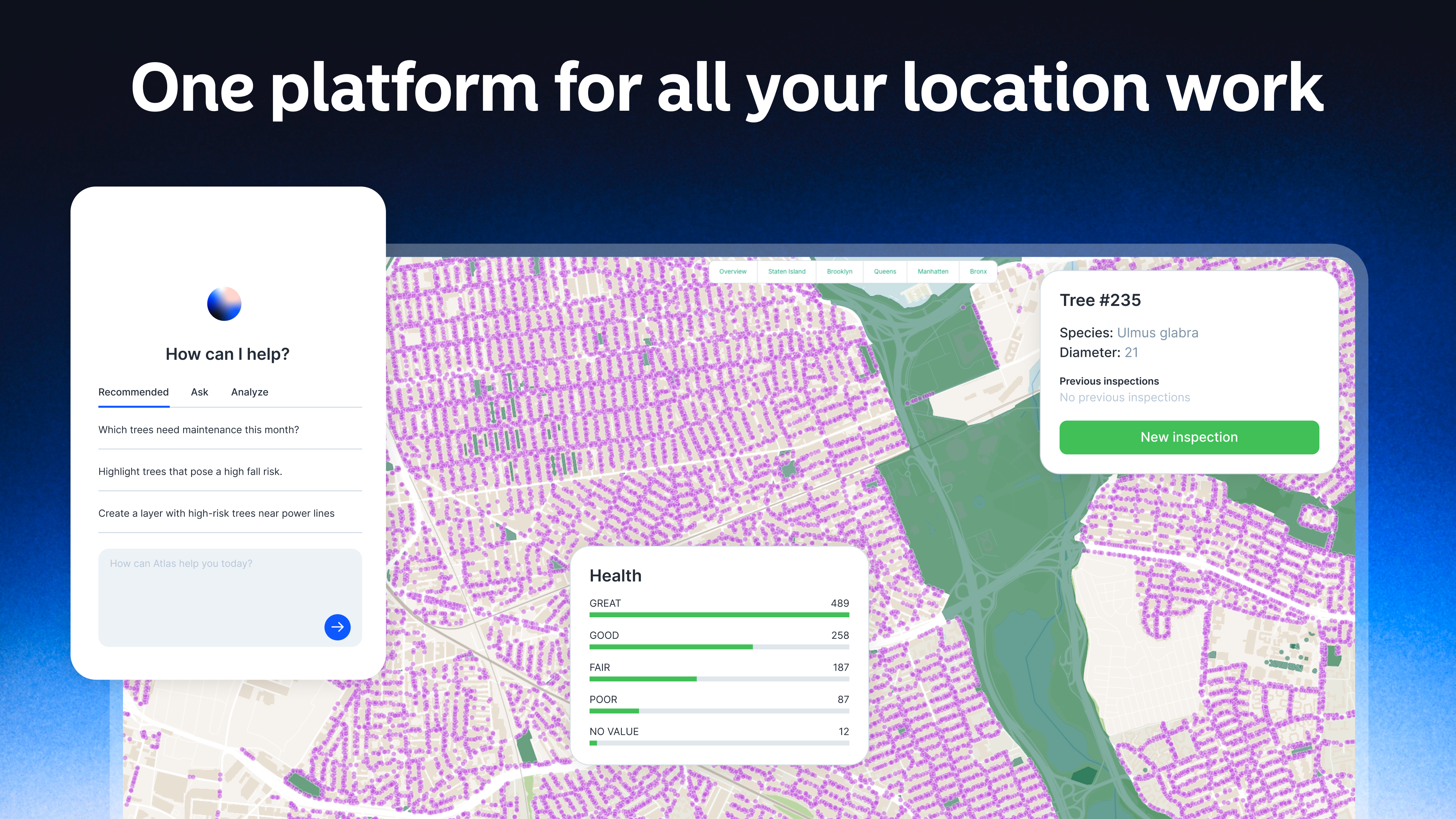
Atlas.new: The AI Agent Democratizing Maps and Spatial Data Analysis
The AI agent for maps and spatial data
发布时间: 1/12/2026
Atlas.new is making a bold claim: to bring the complex world of Geographic Information Systems (GIS) and spatial data analysis to the masses, no specialist training required. Billed as "The AI agent for maps and spatial data," this tool aims to bridge the significant technical gap that typically isolates business users, marketers, and general data analysts from leveraging powerful location intelligence. In a world increasingly driven by geography—from logistics and real estate to environmental monitoring—Atlas.new seeks to unlock spatial understanding through conversational AI.
Product Overview: Conversational Power for Spatial Intelligence
Atlas.new fundamentally operates as an intelligent intermediary between users and geospatial datasets. Instead of wrestling with proprietary GIS software like ArcGIS or QGIS, users interact with Atlas.new using natural language prompts to generate maps, perform sophisticated spatial queries, and even construct rudimentary spatial applications. This positions Atlas.new as a vital tool for data democratization, removing the steep learning curve associated with traditional cartography and spatial statistics.
The core value proposition of Atlas.new is speed and accessibility. For professionals whose primary domain isn't geography but who constantly need location-based insights—think business development managers needing to visualize sales territories or urban planners quickly prototyping zoning overlays—this tool promises immediate, actionable visualizations and analyses. It’s designed for anyone who has ever thought, "If only I could easily overlay this spreadsheet data onto a map and see what happens."
Problem & Solution: Eliminating the GIS Gatekeeper
The perennial problem in location intelligence is the reliance on highly specialized GIS analysts. Data analysts often possess the raw information but lack the specific software proficiency to transform that data into meaningful geographic insights. If a manager needs a quick suitability analysis (e.g., "Show me all retail locations within a 5-mile drive time of our top 10 customers"), this request typically involves tedious data preparation, complex buffer creation, and manual map styling—a process that can take hours or days if the analyst is occupied.
Atlas.new solves this by embedding sophisticated spatial processing within a generative AI framework. Users simply describe the analysis they want. The AI agent translates this natural language request into the necessary spatial operations (geocoding, buffering, overlay analysis, routing) and delivers the resulting map or data output. This approach fills a significant market gap: the lack of an intuitive, high-powered, self-service platform for on-demand geospatial discovery.
Key Features & Highlights: AI-Powered Cartography
Atlas.new seems to focus heavily on making complex spatial tasks effortless through its AI engine. Based on its description, we can anticipate several powerful capabilities:
- Natural Language Mapping: Users can ask Atlas.new to "Map the distribution of reported incidents across Seattle last quarter, colored by time of day," and receive an immediate, styled choropleth or point map.
- Automated Spatial Analysis: Beyond simple visualization, the agent promises true analysis, such as calculating proximity, finding centroids, or running trade area analyses simply by describing the parameters.
- Spatial Application Building: The capability to "build spatial apps" suggests users can create interactive dashboards or simple tools that others can use, all configured via AI commands, bypassing the need for coding environments like Leaflet or Mapbox GL.
- Data Ingestion Flexibility: Implicit in its promise is the ability to handle various input formats (likely CSVs, shapefiles, or direct API connections) and intelligently process coordinates and attribute data for mapping.
The user experience highlight is clearly the abstraction layer. By removing technical barriers, Atlas.new allows domain experts to focus purely on the insight they are seeking, rather than the mechanics of generating the map.
Potential Drawbacks & Areas for Improvement
While the promise of Atlas.new is exciting, a few crucial areas will determine its long-term viability and user trust. The most immediate potential drawback lies in the accuracy and complexity handling of the AI model. Geospatial data requires high precision; if the AI misinterprets a spatial relationship or uses an incorrect projection, the resulting "analysis" could be fundamentally flawed and lead to poor decision-making.
Constructive criticism would focus on transparency and scalability:
- Auditability: For mission-critical applications, users must be able to see how the AI generated the map or result. A "Show Me The Code/Steps" button is essential for debugging and validating the AI’s spatial logic.
- Data Security and Size: For enterprise adoption, clear assurances on data handling, privacy policies, and the capacity to process very large vector or raster datasets will be non-negotiable.
- Customization: While initial visualizations will be fast, advanced users will inevitably need granular control over symbology, labeling, and layer ordering—areas where pure AI generation might feel too prescriptive.
Bottom Line & Recommendation
Atlas.new is a compelling innovation for the growing cohort of non-GIS professionals who need location intelligence now. If you are a data analyst, marketer, operations manager, or small business owner frustrated by the complexity of traditional mapping software, Atlas.new is absolutely worth trying. It sets a new standard for accessibility in geospatial technology. While we advise initial users to cross-reference complex AI-generated outputs with known data points until trust in the system is established, this tool has the potential to fundamentally shift who gets to wield the power of spatial data. For rapid prototyping and insight generation, Atlas.new looks poised to become an indispensable AI agent.
Featured AI Applications
Discover powerful tools to enhance your productivity
MindMax
与AI互动的新方式
超越 AI 聊天,将对话转化为无限画布。结合头脑风暴、思维导图、批判性与创造性思维工具,帮助你可视化想法、高效解决问题、加速学习。
AI Slides
AI 驱动幻灯片,Markdown 魔法加持
革命性幻灯片创作,融合 AI 智能与 Markdown 灵活性 - 随处编辑,随时优化,轻松迭代。让每个想法,都能快速变成专业演示。
AI Markdown Editor
打开即写 - AI驱动的Markdown编辑器
极其高效的写作体验:AI助手、斜杠命令、极简界面。打开即用,轻松写作。✍️ Markdown简洁 + 🤖 AI强大 + ⚡ 斜杠命令 = 完美写作体验
FunBlocks AI Extension
🚀 AI驱动的浏览器扩展
用FunBlocks AI助手改变您的浏览体验。您的智能伴侣,为网络上的AI驱动阅读、写作、头脑风暴和批判性思维提供支持。