Claude Opus 4.7: The New Gold Standard for Agentic Coding and Complex Reasoning
Claude’s most capable model for reasoning and agentic coding
发布时间: 4/17/2026
Product Overview
Claude Opus 4.7 is the latest flagship model from Anthropic, positioned as their most capable AI intelligence to date. Designed specifically for high-stakes tasks, this model is built to handle the heavy lifting that smaller, general-purpose LLMs often stumble upon. Whether you are a developer looking for an autonomous coding partner or a researcher analyzing massive datasets, Claude Opus 4.7 aims to bridge the gap between simple chatbots and sophisticated, agentic AI.
The target audience for this release is primarily power users, software engineers, and enterprise professionals who require precision over speed. By prioritizing deep reasoning and long-context performance, Claude Opus 4.7 moves away from the "quick answer" paradigm and toward a "thoughtful execution" model. It is designed to act not just as a text generator, but as a reliable agent capable of managing multi-step workflows with minimal oversight.
Problem & Solution
The current AI landscape is crowded with models that excel at creative writing or short-form queries but often suffer from "hallucinations" or logical drift when tasked with long-running, technical projects. Developers frequently encounter AI that suggests syntactically correct code that fails in the real world because the model lacks a deep understanding of the broader system architecture.
Claude Opus 4.7 addresses this by emphasizing high-fidelity instruction following and internal verification. By shifting the focus toward agentic coding, the model significantly reduces the "ping-pong" effect where a user has to constantly correct the AI’s output. It fills a critical market gap for a tool that can "think" before it acts, offering a level of reliability that is essential for production-grade coding environments and complex analytical research.
Key Features & Highlights
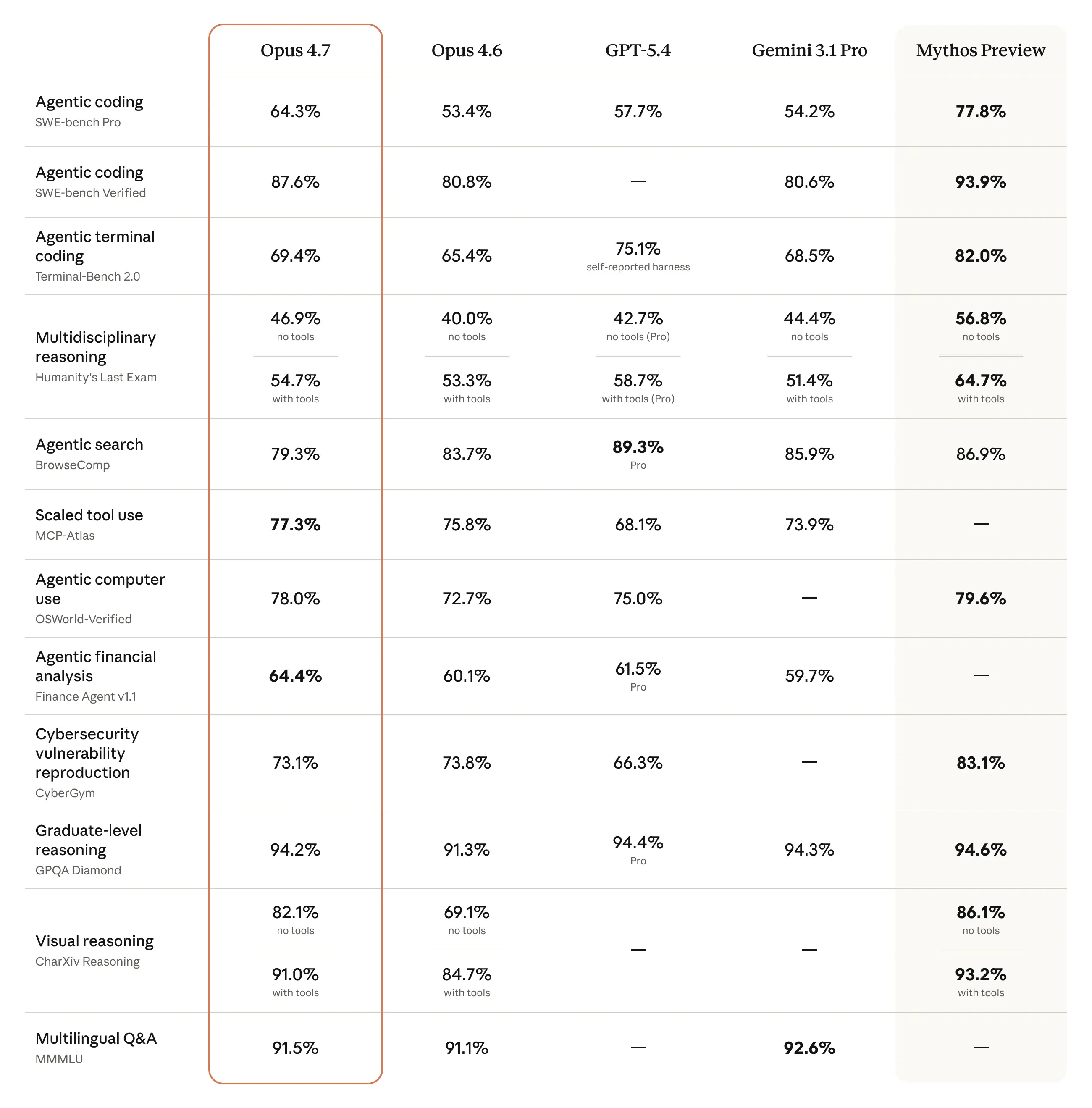
The core strength of Claude Opus 4.7 lies in its sophisticated reasoning engine. Unlike standard models, it is optimized to perform internal verification, meaning it checks its own logic against the constraints provided before delivering a final result. Key highlights include:
- Agentic Coding Capabilities: Designed to navigate complex codebases, refactor existing structures, and implement features across multiple files without losing the context of the larger project.
- Long-Running Task Management: Unlike lightweight models that fatigue, Opus 4.7 is engineered to maintain high performance over extended sessions, making it ideal for deep research and comprehensive data synthesis.
- Precision-First Instruction Following: A marked improvement in adherence to complex, multi-layered instructions, reducing the need for iterative prompting.
- Enhanced Logical Reasoning: Superior performance in mathematical, logical, and structural tasks where accuracy is paramount.
The user experience is noticeably more professional and "deliberate." When working with the model, you get the sense that it is processing the intent behind the query rather than just matching patterns, which leads to a more seamless collaboration flow for developers.
Potential Drawbacks & Areas for Improvement
While Claude Opus 4.7 is a massive leap forward, it is not without its trade-offs. The model’s deep reasoning capability often comes at the cost of latency; it is slower than "Flash" or "Haiku-class" models, making it less ideal for real-time customer support chat interfaces where instantaneous response times are required.
Furthermore, users might find that the model is somewhat "over-cautious." In scenarios where a quick, approximate answer would suffice, Opus 4.7 might spend unnecessary compute cycles trying to be perfect, which can feel like overkill. Future iterations would benefit from a "performance mode" toggle that allows users to balance the depth of reasoning against the speed of output, depending on the specific urgency of the task.
Bottom Line & Recommendation
Claude Opus 4.7 is an essential tool for any professional who has found mainstream AI models to be either too generic or too prone to error for their technical work. If your workflow involves complex coding, architectural planning, or deep analysis, the investment in Opus 4.7 is easily justified by the time saved in debugging and iterative correction.
While it may not be the optimal choice for simple, high-speed query answering, it stands currently as one of the most reliable and intelligent models for high-level problem-solving. For those looking to upgrade their AI agent stack, Claude Opus 4.7 is highly recommended as a robust, enterprise-ready solution.
Featured AI Applications
Discover powerful tools to enhance your productivity
MindMax
与AI互动的新方式
超越 AI 聊天,将对话转化为无限画布。结合头脑风暴、思维导图、批判性与创造性思维工具,帮助你可视化想法、高效解决问题、加速学习。
AI Slides
AI 驱动幻灯片,Markdown 魔法加持
革命性幻灯片创作,融合 AI 智能与 Markdown 灵活性 - 随处编辑,随时优化,轻松迭代。让每个想法,都能快速变成专业演示。
AI Markdown Editor
打开即写 - AI驱动的Markdown编辑器
极其高效的写作体验:AI助手、斜杠命令、极简界面。打开即用,轻松写作。✍️ Markdown简洁 + 🤖 AI强大 + ⚡ 斜杠命令 = 完美写作体验
FunBlocks AI Extension
🚀 AI驱动的浏览器扩展
用FunBlocks AI助手改变您的浏览体验。您的智能伴侣,为网络上的AI驱动阅读、写作、头脑风暴和批判性思维提供支持。