Cowork Review: Turning Claude into a Truly Autonomous Digital Coworker
Turn Claude into your digital coworker
发布时间: 1/13/2026
Product Overview: The Next Evolution of AI Assistance
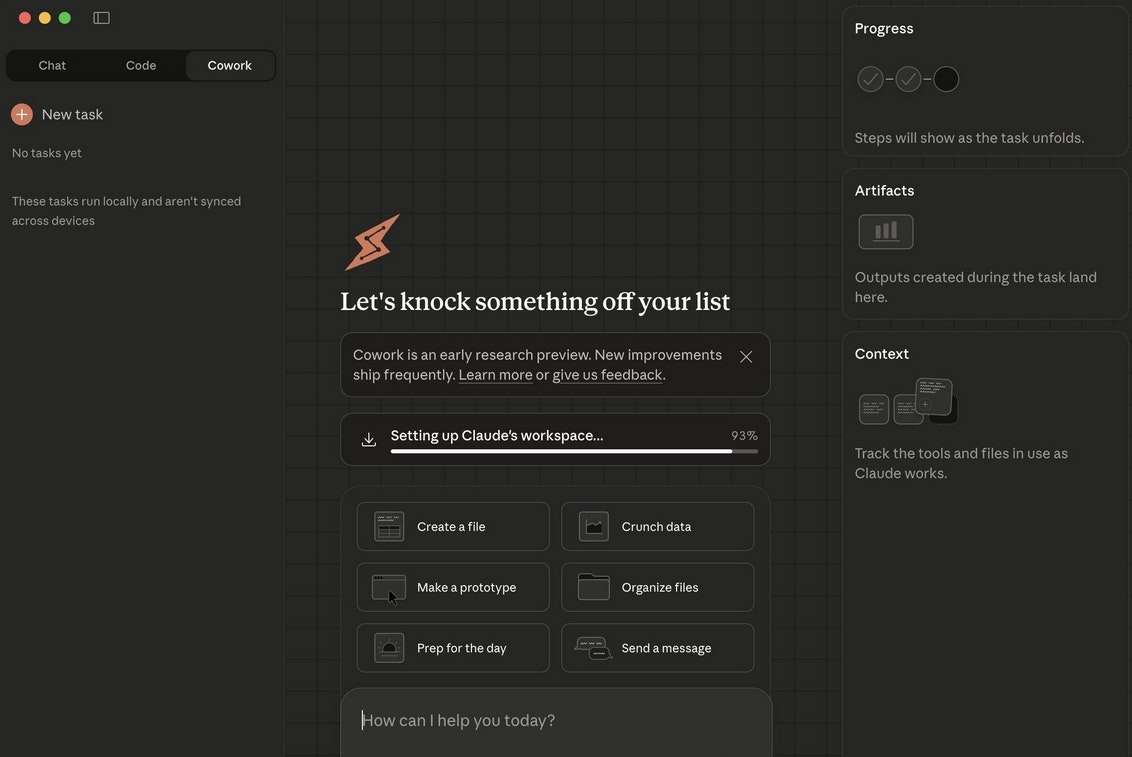
Cowork is not just another chatbot interface; it represents a significant leap toward practical, autonomous AI agents integrated directly into your existing workflow. Taglined as turning Claude into your digital coworker, Cowork fundamentally shifts the paradigm from reactive prompting to proactive task delegation. Instead of engaging in lengthy back-and-forth conversations to coax a specific output, users can now assign complex, multi-step tasks to Claude via this platform, much like delegating to a human team member.
The core innovation behind Cowork lies in granting the Large Language Model (LLM)—specifically Claude, in this iteration—the critical ability to interact with your local file system. This access allows it to read existing documents, logically plan out the steps needed to achieve a goal, modify files, and generate new content directly where it belongs. This moves AI assistance beyond simple text generation into genuine workflow execution, promising a future where tedious digital chores are managed seamlessly in the background.
This tool is primarily aimed at knowledge workers, developers, small business owners, and power users who are already heavily invested in LLMs like Claude for productivity gains but are frustrated by the "chat barrier." If your daily workflow involves analyzing, synthesizing, or restructuring information locked within local files, Cowork is designed to bridge that gap between AI capability and real-world application.
Problem & Solution: Bridging the Execution Gap
The primary problem Cowork addresses is the inherent limitation of standard LLM interfaces: they are inherently siloed within the chat window. You can ask Claude to write a report, but you then have to manually copy, paste, format, and save that report. This creates significant friction and context switching, negating much of the potential time savings. Furthermore, tasks requiring sequential logic across multiple files—like merging data from three spreadsheets and generating a summary PDF—are nearly impossible without extensive manual intervention.
Cowork solves this by acting as an orchestrator. By giving Claude secure, defined access to a specific folder, users can assign a high-level goal (e.g., "Analyze Q3 marketing data in this folder, draft an executive summary, and save it as a new document"). Claude then plans the internal steps, executes the file read/write operations, and delivers the final product. This drastically reduces the "back-and-forth" and fills a crucial market gap: persistent, file-aware, goal-oriented AI agents running locally under user supervision.
Key Features & Highlights: Autonomous, Controlled Action
The features that make Cowork stand out center on its ability to operate autonomously while maintaining essential user oversight.
- Direct File System Interaction: The ability for Claude to read, edit, and create files within a designated folder is the cornerstone feature. This unlocks true operational capacity far beyond simple text generation.
- Task Planning and Execution: Users assign an objective, and Cowork enables Claude to generate an internal execution plan, providing transparency into the AI's strategy before it acts. This mitigates the "black box" nature of many autonomous systems.
- User Control Loop: Critically, the description emphasizes that the user remains "in control." This suggests an intermediate checkpoint system or at least the ability to review and veto actions before final execution, which is vital for high-stakes data manipulation.
The user experience, based on the concept, should be centered around clear delegation screens rather than complex prompt engineering. If implemented smoothly, assigning tasks should feel intuitive, freeing up cognitive load previously spent managing the AI's output lifecycle.
Potential Drawbacks & Areas for Improvement
While the promise of Cowork is immense, the implementation details will heavily dictate its success, particularly concerning security and complexity management.
A key area for constructive criticism revolves around the security implications of granting file system access. While the product likely confines access to specific folders, ensuring robust, impenetrable security protocols against prompt injection leading to unintended file deletions or data leakage will be paramount for user adoption. Clear, granular permission settings would be a significant enhancement.
Additionally, for complex multi-step processes, users might struggle with troubleshooting when the end result isn't what was expected. Improving the audit log and execution visibility is crucial. If Claude fails a task, the user needs an easy way to see exactly where in its planned steps it went wrong so they can refine the initial objective. Expanding the list of supported LLMs beyond Claude in the future would also broaden its appeal significantly.
Bottom Line & Recommendation
Cowork is positioning itself at the forefront of practical generative AI deployment. For advanced users and small teams struggling with the transition from "prompting" to "delegating," this tool offers a genuinely novel solution for automating file-based cognitive tasks.
If you are ready to move beyond simple chat interactions and want to leverage Claude's reasoning capabilities directly within your operational documents, Cowork is highly recommended. It transforms a powerful language model into a functional, if still supervised, digital team member capable of executing end-to-end file workflows. Try it if you value deep integration and autonomous task completion over simple text generation.
Featured AI Applications
Discover powerful tools to enhance your productivity
MindMax
与AI互动的新方式
超越 AI 聊天,将对话转化为无限画布。结合头脑风暴、思维导图、批判性与创造性思维工具,帮助你可视化想法、高效解决问题、加速学习。
AI Slides
AI 驱动幻灯片,Markdown 魔法加持
革命性幻灯片创作,融合 AI 智能与 Markdown 灵活性 - 随处编辑,随时优化,轻松迭代。让每个想法,都能快速变成专业演示。
AI Markdown Editor
打开即写 - AI驱动的Markdown编辑器
极其高效的写作体验:AI助手、斜杠命令、极简界面。打开即用,轻松写作。✍️ Markdown简洁 + 🤖 AI强大 + ⚡ 斜杠命令 = 完美写作体验
FunBlocks AI Extension
🚀 AI驱动的浏览器扩展
用FunBlocks AI助手改变您的浏览体验。您的智能伴侣,为网络上的AI驱动阅读、写作、头脑风暴和批判性思维提供支持。