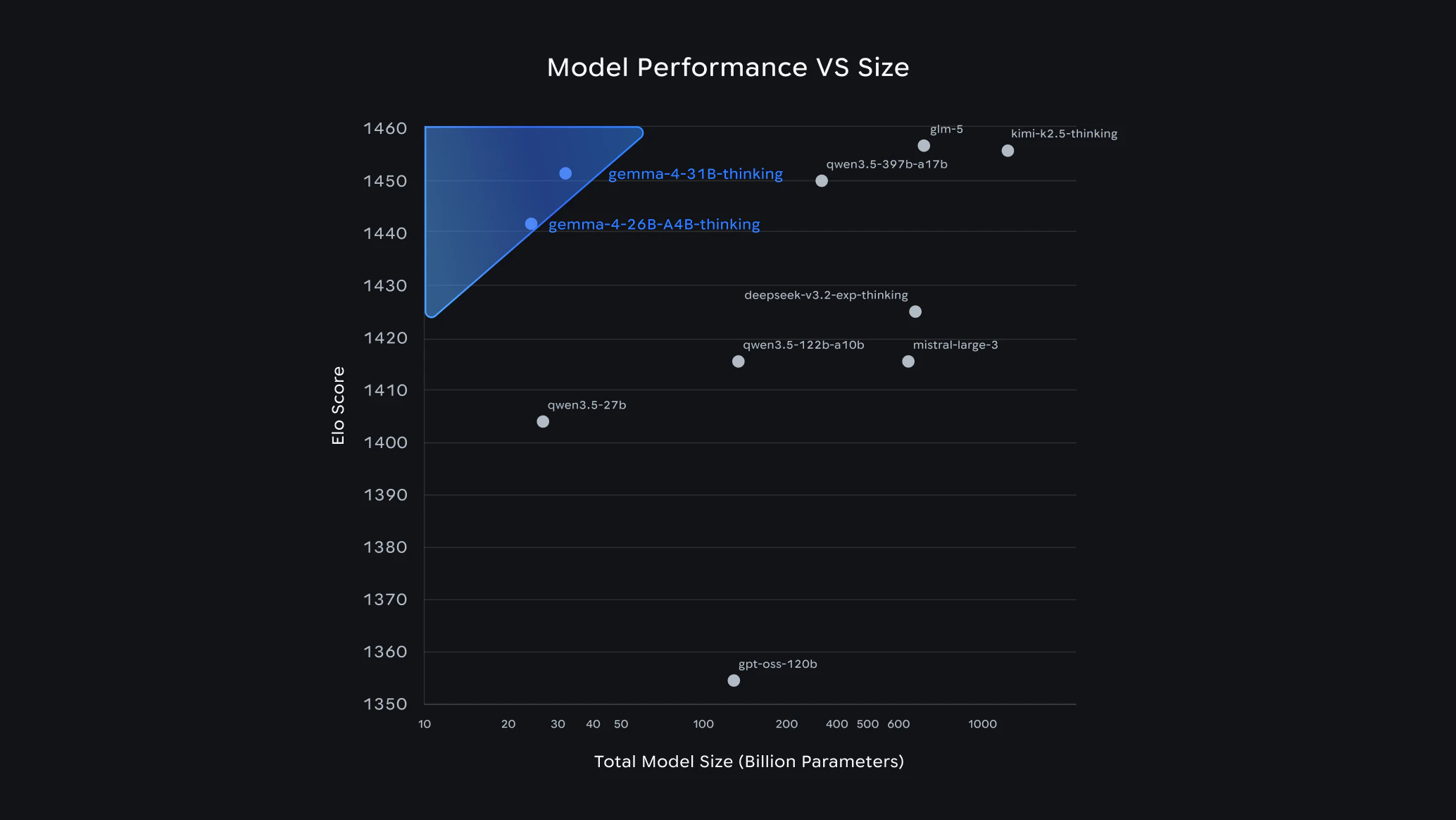
Google Gemma 4: Setting a New Gold Standard for Open-Weight AI
Google's most intelligent open models to date
发布时间: 4/3/2026
Product Overview
Google Gemma 4 represents a significant leap forward in the ecosystem of open-model artificial intelligence. As the latest iteration of Google DeepMind’s open model family, Gemma 4 is designed to bridge the gap between massive, closed-source foundation models and accessible, developer-friendly tools. It is engineered to provide advanced reasoning, sophisticated multimodal capabilities, and support for complex agentic workflows—all within a framework that allows for local deployment and fine-tuning.
The target audience for Gemma 4 is broad, ranging from individual hobbyist developers and researchers to enterprise engineering teams looking to integrate AI into mobile apps or cloud-based infrastructure. By offering high performance with a focus on efficient compute overhead, it serves as the ideal backbone for building everything from real-time document analysis tools to interactive AI agents that operate closer to the edge.
Problem & Solution
The current AI landscape is often split between two extremes: highly capable models that are restricted behind expensive, opaque APIs, or open-source models that lack the reasoning prowess required for modern, agent-based applications. Developers frequently face a trade-off where choosing "open" means sacrificing the ability to process images or perform complex, multi-step logical reasoning.
Google Gemma 4 addresses this market gap by delivering a "best of both worlds" solution. It provides the architectural intelligence of top-tier proprietary models while maintaining the flexibility of open-weight distributions. By optimizing the model for everything from resource-constrained mobile devices to high-end GPU clusters, Google has effectively democratized the ability to build production-grade, agentic AI without being tethered to a singular cloud provider's walled garden.
Key Features & Highlights
Gemma 4 is not just an incremental update; it introduces a suite of capabilities that fundamentally change how developers approach local AI deployment. Its focus on agentic workflows makes it particularly suited for modern automation tasks where the AI must interact with external tools or perform iterative problem-solving.
Core highlights include:
- Advanced Reasoning: Improved logical depth, making it suitable for complex coding tasks, mathematical problem-solving, and nuanced content generation.
- Multimodal Processing: Native support for processing multiple types of data—text, imagery, and potentially more—without relying on bulky, separate integration layers.
- High Efficiency & Optimization: Built to minimize compute overhead, ensuring developers can achieve high throughput on consumer-grade hardware or mobile processors.
- Developer-First Ecosystem: Seamless integration with standard machine learning frameworks (JAX, PyTorch, TensorFlow), allowing developers to move from prototyping to deployment rapidly.
The user experience is characterized by a "plug-and-play" ethos that avoids the configuration nightmares often associated with open-source models. The efficiency gains mean that latency is reduced significantly compared to previous generations, making it a compelling choice for user-facing applications.
Potential Drawbacks & Areas for Improvement
Despite its impressive performance, Google Gemma 4 is not without its limitations. For one, while the model is "open," its licensing terms and usage conditions still require careful review, particularly for large-scale commercial deployments where proprietary data security is a concern. Additionally, while the model is optimized for mobile and edge devices, truly running these higher-parameter versions on basic hardware may still require significant quantization, which can lead to a slight degradation in the "intelligence" of the response.
I would love to see Google provide more comprehensive documentation or a "playground" environment that allows developers to test fine-tuning recipes specific to different industry verticals (e.g., healthcare or legal) to reduce the time-to-market for specialized applications.
Bottom Line & Recommendation
Google Gemma 4 is an essential tool for any developer or startup looking to build a high-performance AI application without the limitations of vendor lock-in. Whether you are building an autonomous agent, a multimodal content generator, or a privacy-focused local assistant, the combination of reasoning power and compute efficiency makes Gemma 4 the current front-runner in the open-model space. I highly recommend that developers experiment with the Gemma 4 family today; it is easily the most versatile and capable open-weight model Google has released to date.
Featured AI Applications
Discover powerful tools to enhance your productivity
MindMax
与AI互动的新方式
超越 AI 聊天,将对话转化为无限画布。结合头脑风暴、思维导图、批判性与创造性思维工具,帮助你可视化想法、高效解决问题、加速学习。
AI Slides
AI 驱动幻灯片,Markdown 魔法加持
革命性幻灯片创作,融合 AI 智能与 Markdown 灵活性 - 随处编辑,随时优化,轻松迭代。让每个想法,都能快速变成专业演示。
AI Markdown Editor
打开即写 - AI驱动的Markdown编辑器
极其高效的写作体验:AI助手、斜杠命令、极简界面。打开即用,轻松写作。✍️ Markdown简洁 + 🤖 AI强大 + ⚡ 斜杠命令 = 完美写作体验
FunBlocks AI Extension
🚀 AI驱动的浏览器扩展
用FunBlocks AI助手改变您的浏览体验。您的智能伴侣,为网络上的AI驱动阅读、写作、头脑风暴和批判性思维提供支持。