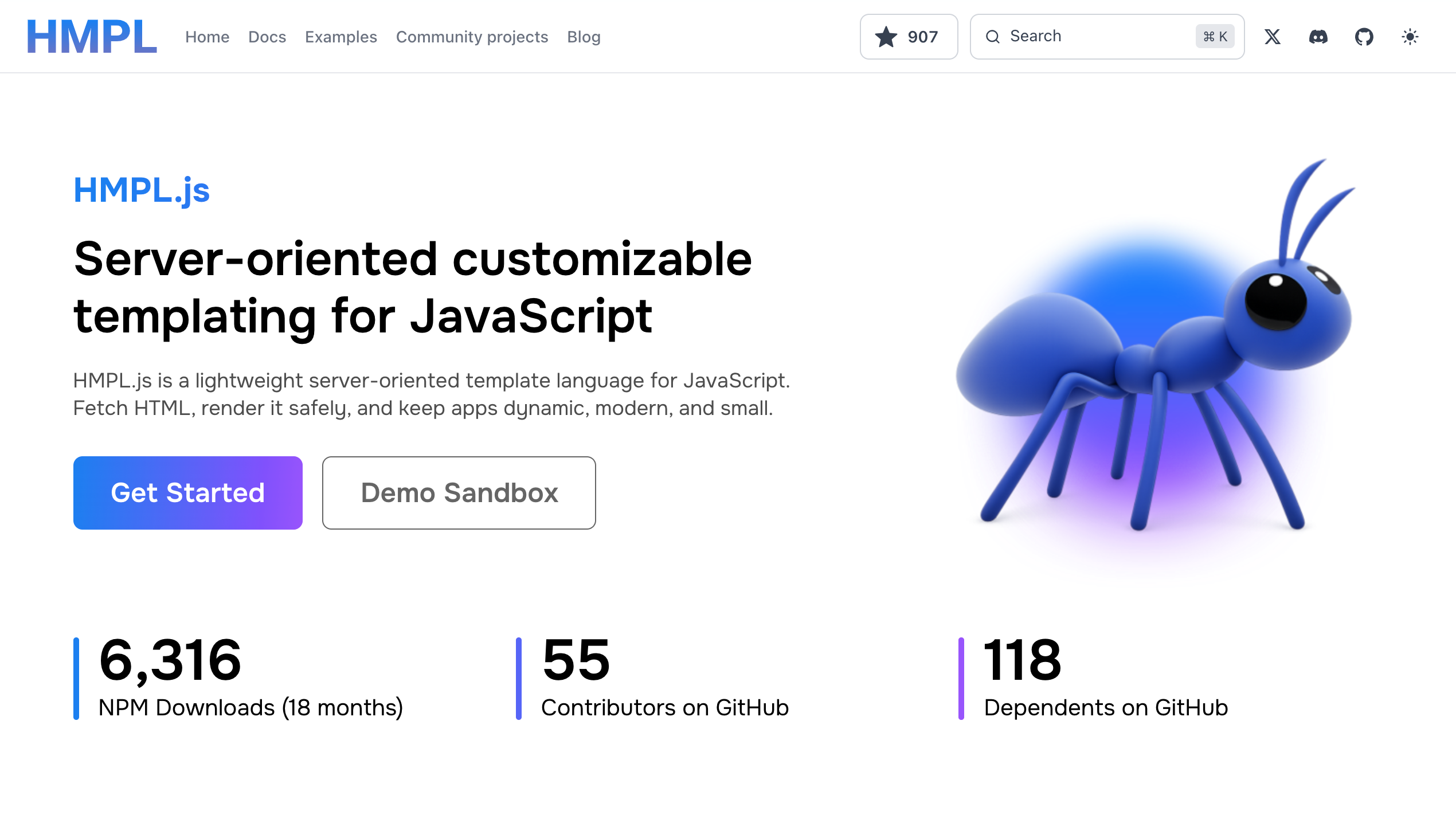
HMPL Review: The Lightweight Contender for Server-Oriented JavaScript Templating
Lightweight server-oriented template language for JavaScript
发布时间: 12/28/2025
Product Overview: Redefining Lightweight UI Development
HMPL, boasting the tagline "Lightweight server-oriented template language for JavaScript," enters the crowded front-end ecosystem promising simplicity and speed. At its core, HMPL is designed to bridge the gap between static HTML generation and the heavy overhead of large JavaScript frameworks. It offers developers a way to build highly dynamic, server-driven user interfaces using minimal client-side JavaScript ballast.
This language targets developers and teams who prioritize performance, bundle size, and granular control over their rendering pipeline. It’s ideal for projects where delivering content quickly and efficiently is paramount, such as internal tooling, specialized widgets, or high-traffic marketing sites that require dynamic interactions without the complexity of a full Single Page Application (SPA) architecture. The core value proposition of HMPL lies in its focused feature set—allowing server logic to dictate UI updates efficiently.
Problem & Solution: Escaping Framework Bloat
The modern web development landscape is often characterized by dependency bloat. Developers frequently reach for powerful, but large, client-side frameworks to manage simple state changes or dynamic data fetching, leading to slower initial load times and increased maintenance complexity. HMPL specifically addresses this problem by shifting much of the required interactivity back towards the server.
HMPL solves this by embedding server-centric capabilities directly into its template syntax. Instead of managing complex state reconciliation on the client, users leverage HMPL’s block-based syntax to define dynamic regions that can be refreshed based on events, forms, or scheduled synchronization. This approach directly targets the market gap between pure static site generation and heavy client-side rendering frameworks, offering a "just enough" dynamic solution.
Key Features & Highlights: Power in Kilobytes
The standout aspect of HMPL is its commitment to being lightweight. Everything in its design appears optimized for minimal footprint, which is a significant selling point for performance-conscious engineers.
The feature set is surprisingly robust for such a small library:
- Block-Based Syntax: Provides a clear, structured way to define template regions that are targetable for updates.
- Customizable Fetch Requests: Enables developers to easily define how and when data is pulled from the server directly within the template logic, centralizing data interaction.
- Built-in Interactivity: Native support for handling forms, user events, and time-based syncing means fewer third-party libraries are required for basic dynamic functionality.
- Security & Expressiveness: The integration of JSON5 allows for more flexible, human-readable configuration objects, while DOMPurify ensures that any server-rendered HTML remains safe from XSS vulnerabilities—a critical feature for any template language.
The user experience seems geared towards familiarity for those who have worked with older templating engines but require modern reactivity capabilities without a massive learning curve.
Potential Drawbacks & Areas for Improvement
While HMPL champions lightweight design, this focus inherently introduces trade-offs. The primary consideration for potential users will be the ecosystem maturity. As a newer, specialized tool, documentation, community support, and the availability of pre-built components might be less extensive compared to dominant players like React or Vue.
For enterprise applications requiring complex, deep client-side state management or intricate UI animations, HMPL might hit a ceiling, as its philosophy pushes complexity back to the backend. To enhance its appeal, the developers behind HMPL could benefit from:
- Developing official wrappers or examples showcasing integration with popular backend frameworks (e.g., Express, FastAPI).
- Creating a more robust gallery of advanced use cases beyond basic data fetching.
- Considering first-class TypeScript support if it’s not already fully implemented, to provide enhanced tooling for larger projects.
Bottom Line & Recommendation
HMPL is an exciting entrant for the segment of web development that seeks "progressive enhancement" without full SPA commitment. It offers a compelling alternative for building fast, dynamic interfaces where every kilobyte counts.
I highly recommend HMPL to developers working on performance-critical server-rendered applications, specialized dashboard components, or anyone looking to minimize client-side JavaScript overhead while maintaining modern interactivity. If your project goals are rooted in speed and simplicity over deep, client-side architectural complexity, HMPL is a template language well worth integrating into your workflow.
Featured AI Applications
Discover powerful tools to enhance your productivity
MindMax
与AI互动的新方式
超越 AI 聊天,将对话转化为无限画布。结合头脑风暴、思维导图、批判性与创造性思维工具,帮助你可视化想法、高效解决问题、加速学习。
AI Slides
AI 驱动幻灯片,Markdown 魔法加持
革命性幻灯片创作,融合 AI 智能与 Markdown 灵活性 - 随处编辑,随时优化,轻松迭代。让每个想法,都能快速变成专业演示。
AI Markdown Editor
打开即写 - AI驱动的Markdown编辑器
极其高效的写作体验:AI助手、斜杠命令、极简界面。打开即用,轻松写作。✍️ Markdown简洁 + 🤖 AI强大 + ⚡ 斜杠命令 = 完美写作体验
FunBlocks AI Extension
🚀 AI驱动的浏览器扩展
用FunBlocks AI助手改变您的浏览体验。您的智能伴侣,为网络上的AI驱动阅读、写作、头脑风暴和批判性思维提供支持。