Sonarly Review: The Autonomous AI Agent Revolutionizing Production Incident Response
The AI that fixes prod autonomously
发布时间: 3/10/2026
Product Overview: Moving Beyond Alert Fatigue
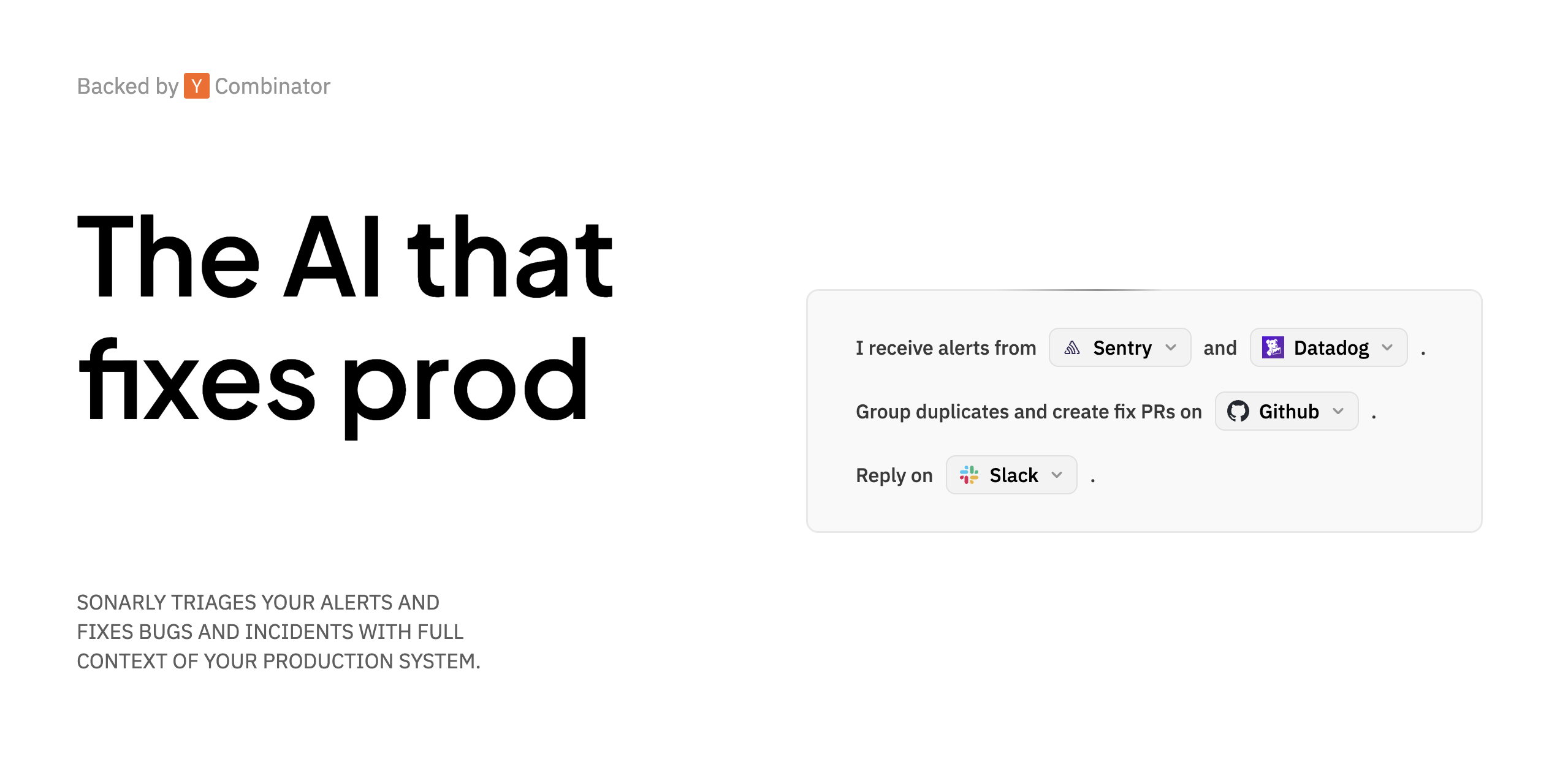
Sonarly is making a bold claim: to be the AI that fixes production autonomously. In the increasingly complex landscape of modern software development, where microservices generate an avalanche of alerts from tools like Sentry and Datadog, alert fatigue is a critical productivity drain. Sonarly positions itself not just as another monitoring aggregator, but as an intelligent incident resolver. By connecting seamlessly to existing observability stacks, the platform takes on the tedious, high-stakes task of triaging, deduplicating, and diagnosing production issues.
This tool is aimed squarely at DevOps teams, SREs (Site Reliability Engineers), and engineering managers grappling with slow incident response times and overwhelming notification volume. The core value proposition of Sonarly is speed and precision in fixing bugs. Instead of an engineer spending hours correlating logs, tracing errors across services, and finally crafting a fix, Sonarly promises to deliver a context-rich, production-aware Pull Request (PR) that often requires only a final review and merge, effectively shrinking Mean Time To Resolution (MTTR) dramatically.
The Problem Sonarly Solves: Context Collapse and Alert Noise
The fundamental problem facing modern engineering teams isn't a lack of monitoring data; it’s the context collapse that occurs when that data floods in. Traditional monitoring tools excel at telling you something broke (e.g., "500 error spike in Service X"), but they fail to deliver the "why" with the necessary production context. Engineers must then manually pivot between multiple dashboards, investigate local reproduction steps, and synthesize scattered evidence. Duplication is rampant—a single underlying failure often triggers dozens of identical alerts across different reporting systems.
Sonarly tackles this noisy inefficiency head-on. Where alternatives merely aggregate data, Sonarly synthesizes actionable intelligence. By leveraging large language models, specifically powered by Claude Code and Opus 4.6, it ingests the raw context of your production environment. It intelligently deduplicates noise, understands the interwoven dependencies of your system, and translates a cryptic error message into a concrete, testable code fix—a capability that truly sets it apart in the AI incident management space.
Key Features and Autonomous Intelligence Highlights
The intelligence underpinning Sonarly is its standout feature. It moves beyond simple root-cause analysis toward autonomous remediation.
- Deep Production Context Integration: Sonarly doesn't rely on shallow data pulls. It integrates deeply with Sentry, Datadog, and other observability platforms to build a comprehensive view of the live system state, ensuring generated fixes are relevant to the current production configuration.
- Intelligent Alert Triage & Deduplication: This is crucial for combating alert fatigue. Sonarly identifies multiple, redundant alerts stemming from a single underlying failure and groups them, presenting engineers with one, singular, prioritized incident ticket.
- AI-Powered Production PR Generation: The crown jewel of the product is the ability to generate a ready-to-submit Pull Request. This PR isn't just suggested code; it comes packaged with evidence—the exact logs, traces, and context that led the AI to propose that specific fix. This transparency builds trust in the autonomous system.
The user experience seems designed to insert itself seamlessly into existing workflows. By delivering the final output as a familiar PR, Sonarly respects the established code review and deployment pipeline, minimizing friction for adoption among skeptical engineering teams.
Potential Drawbacks and Areas for Enhancement
While the vision of autonomous production fixing is thrilling, any tool operating at this level of system access warrants scrutiny regarding reliability and control.
One potential drawback lies in the trust factor associated with fully autonomous fixes. Engineers are inherently cautious about letting an AI merge code directly into production systems without heavy oversight. Future iterations of Sonarly might benefit from offering tiered levels of autonomy—perhaps starting with "AI-drafted suggestion" before moving to "AI-ready PR."
Furthermore, while the integration with Sentry and Datadog is noted, the platform's effectiveness will heavily depend on the quality and breadth of that integration. Expansion into other critical developer tools, such as deeper integration with deployment pipelines (e.g., GitHub Actions, GitLab CI) or configuration management tools, could enhance its ability to apply fixes and confirm successful resolution post-deployment. More granular control over which services or alert types Sonarly is permitted to autonomously manage initially would also ease adoption.
Bottom Line & Recommendation
Sonarly is a highly ambitious and potentially disruptive entry into the DevOps automation and observability markets. For engineering organizations drowning in alerts and seeking a tangible reduction in MTTR, this tool represents the next logical step in leveraging generative AI for operational stability.
Who should try Sonarly? Any team currently spending significant engineering hours on manual alert triage, noise reduction, and basic bug fixing derived from monitoring data. If your team values rapid resolution and has confidence in an AI-assisted workflow, Sonarly promises significant productivity gains. It’s worth a serious evaluation for those ready to embrace autonomous incident response.
Featured AI Applications
Discover powerful tools to enhance your productivity
MindMax
与AI互动的新方式
超越 AI 聊天,将对话转化为无限画布。结合头脑风暴、思维导图、批判性与创造性思维工具,帮助你可视化想法、高效解决问题、加速学习。
AI Slides
AI 驱动幻灯片,Markdown 魔法加持
革命性幻灯片创作,融合 AI 智能与 Markdown 灵活性 - 随处编辑,随时优化,轻松迭代。让每个想法,都能快速变成专业演示。
AI Markdown Editor
打开即写 - AI驱动的Markdown编辑器
极其高效的写作体验:AI助手、斜杠命令、极简界面。打开即用,轻松写作。✍️ Markdown简洁 + 🤖 AI强大 + ⚡ 斜杠命令 = 完美写作体验
FunBlocks AI Extension
🚀 AI驱动的浏览器扩展
用FunBlocks AI助手改变您的浏览体验。您的智能伴侣,为网络上的AI驱动阅读、写作、头脑风暴和批判性思维提供支持。