Tonkotsu Review: Orchestrating AI Coding Agents Directly from Your Document Workspace
Manage a team of coding agents from a doc
发布时间: 1/23/2026
Tonkotsu enters the rapidly evolving landscape of AI-powered development, offering a refreshingly direct way to manage autonomous coding agents. Tagged with the compelling promise, "Manage a team of coding agents from a doc," Tonkotsu aims to bridge the gap between complex agent orchestration tools and the everyday workflow of developers who live inside documentation, specifications, and project notes. This review dives into how Tonkotsu positions itself as a crucial interface for the next generation of AI-assisted software engineering.
Product Overview: Document-Centric Agent Management
Tonkotsu appears to be an innovative control plane for multi-agent systems designed specifically for software development tasks. In a world where developers frequently use large language models (LLMs) for everything from debugging to feature generation, the bottleneck often shifts from coding itself to effectively instructing, delegating, and tracking the progress of multiple specialized AI agents. Tonkotsu seeks to solve this by centralizing team management directly within a familiar, document-based interface.
The target audience for Tonkotsu is clearly developers, technical leads, and product managers who are experimenting with or relying on autonomous coding agents. Use cases likely involve complex tasks requiring specialization—perhaps one agent handles database schema design, another focuses on front-end component development, and a third manages integration testing. Tonkotsu’s core value proposition is delivering clarity and control over these asynchronous, potentially chaotic team efforts through a streamlined GUI layered over the project specification document.
Problem & Solution: Cutting Through Agent Overload
The primary problem Tonkotsu addresses is the current complexity of orchestrating AI development teams. Traditional agent frameworks often require deep command-line interaction, intricate configuration files, or clunky web interfaces to define roles, communication protocols, and goal hierarchies for autonomous actors. This overhead negates much of the efficiency gain promised by the agents themselves.
Tonkotsu cuts through this by embedding management directly into the source of truth—the project document. Imagine drafting a set of requirements in a simple text editor, highlighting a section, and instantly assigning a specialized Tonkotsu agent to tackle just that requirement. This document-centric approach dramatically lowers the cognitive load associated with coordinating AI efforts, making agent deployment as simple as editing text. It fills a vital market gap for intuitive, low-friction orchestration tools.
Key Features & Highlights
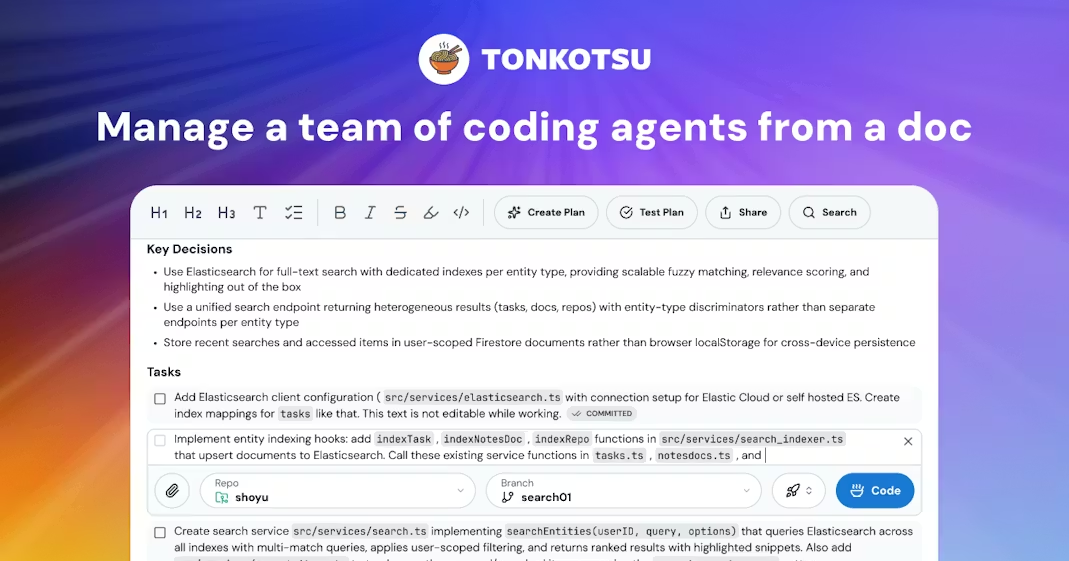
While the provided information is high-level, the visual representation strongly suggests a clean, focused Graphical User Interface (GUI) designed for clarity. The most notable feature is the promised integration between documentation and execution. This suggests:
- In-Document Assignment: The ability to assign specific tasks or roles to agents directly adjacent to the relevant text block or requirement within the management document.
- Team Visualization: A clear overview showing which agents are active, their current status, and their assigned focus areas, preventing duplication of effort.
- Focused Environment: The tagline emphasizes a "clean, focused GUI," implying that Tonkotsu strips away unnecessary complexity often found in broader development IDEs or agent frameworks, focusing purely on team management and monitoring.
The user experience seems geared towards rapid iteration and clear oversight—crucial elements when managing non-human team members whose execution paths can be opaque. Early access users should pay close attention to how seamlessly an instruction in the doc translates into agent action and how easy it is to interrupt or re-route an agent mid-task.
Potential Drawbacks & Areas for Improvement
As an early access product, Tonkotsu likely faces challenges common to novel orchestration layers. The main potential drawback revolves around the depth of integration versus the flexibility offered. If the "doc" abstraction becomes too rigid, complex engineering scenarios requiring dynamic role changes or cross-agent communication management might prove difficult to configure solely through the document interface.
Constructive suggestions for enhancement would center on debugging and transparency:
- Granular Logging: While the GUI should remain clean, developers will need easy access to detailed logs or tracebacks for agents running into errors. How easily can a user pivot from the high-level document view to deep diagnostic data?
- Custom Agent Configuration: For advanced users, the ability to inject specific model parameters, temperature settings, or custom tooling instructions for individual agents via the document interface would significantly boost utility.
- Integrations: Compatibility with popular project management documentation systems (like Notion, Confluence, or markdown editors) will be key to broad adoption.
Bottom Line & Recommendation
Tonkotsu represents a promising evolution in how we interact with AI development teams, shifting orchestration from code abstraction layers to human-readable documentation. If you are a developer or technical manager actively leveraging autonomous AI agents for software tasks and find current management interfaces cumbersome or overly complex, Tonkotsu is a must-try during its early access program. The promise of managing powerful coding assistants simply by editing your project brief is compelling. Its success hinges on delivering a truly seamless, intuitive link between textual intent and autonomous execution. Developers looking to maximize efficiency in their AI co-pilot workflows should definitely explore this fresh approach to agent management.
Featured AI Applications
Discover powerful tools to enhance your productivity
MindMax
与AI互动的新方式
超越 AI 聊天,将对话转化为无限画布。结合头脑风暴、思维导图、批判性与创造性思维工具,帮助你可视化想法、高效解决问题、加速学习。
AI Slides
AI 驱动幻灯片,Markdown 魔法加持
革命性幻灯片创作,融合 AI 智能与 Markdown 灵活性 - 随处编辑,随时优化,轻松迭代。让每个想法,都能快速变成专业演示。
AI Markdown Editor
打开即写 - AI驱动的Markdown编辑器
极其高效的写作体验:AI助手、斜杠命令、极简界面。打开即用,轻松写作。✍️ Markdown简洁 + 🤖 AI强大 + ⚡ 斜杠命令 = 完美写作体验
FunBlocks AI Extension
🚀 AI驱动的浏览器扩展
用FunBlocks AI助手改变您的浏览体验。您的智能伴侣,为网络上的AI驱动阅读、写作、头脑风暴和批判性思维提供支持。