FunBlocks AIFlow: Solve Complex Problems the Way Charlie Munger Thinks
Most AI Tools Give You an Answer. Munger Would Call That Dangerous.
Ask any AI chatbot "why is my user retention dropping?" and you'll get a decent list of suggestions. Organized, readable, and almost entirely useless for hard problems.
Why? Because complex problems don't yield to a single perspective. Charlie Munger spent a lifetime proving this. His answer — the one that helped build Berkshire Hathaway into one of the greatest investment machines in history — was the Latticework of Mental Models: a cross-disciplinary framework that forces you to triangulate truth through multiple lenses before reaching a conclusion.
FunBlocks AIFlow brings this philosophy into an AI-powered thinking tool. It doesn't just answer your question. It thinks about your question the way Munger would.
What Is Munger's Latticework of Mental Models?
Munger's core insight is deceptively simple: every academic discipline has developed a set of powerful models for understanding reality. Most people only learn the models from their own field — and then try to apply them to everything.
"To the man with a hammer, everything looks like a nail."
His solution? Build a latticework — a mental grid of 80 to 100 models drawn from across disciplines — and use them simultaneously to analyze any situation:
- Physics & Systems: Feedback loops, critical mass, entropy, equilibrium
- Biology & Evolution: Natural selection, adaptation, ecosystems, redundancy
- Psychology & Behavior: Loss aversion, incentive bias, social proof, psychological denial
- Economics & Business: Opportunity cost, comparative advantage, creative destruction, moats
- Mathematics & Logic: Compounding, inversion, Bayesian thinking, power laws
- Engineering: Margin of safety, root cause analysis, redundancy design
- History & Philosophy: Second-order effects, Occam's Razor, circle of competence
This isn't academic theory. Munger used this framework to make investment decisions, evaluate businesses, and understand human behavior with remarkable accuracy across decades. The models don't just add up — they interact, creating insights that no single model could produce alone.
How FunBlocks AIFlow Turns This Into a Usable Tool
The Core Mechanism: Multi-Model Parallel Analysis
When you input a topic or problem into AIFlow, the system first determines what kind of thinking is needed:
- Topic Exploration — for deep understanding of complex subjects (e.g., "Inflation", "Blockchain", "Consciousness")
- Problem Solving — for structured analysis of real challenges (e.g., "Why does my startup keep losing customers?", "How do I build better habits?")
From there, AIFlow selects 6 to 8 of the most relevant mental models from Munger's latticework — not randomly, but chosen specifically because they illuminate distinct facets of your particular input. Each model becomes a lens. Each lens generates its own branches of insight, strategies, and implications.
The output is a structured mind map: visual, hierarchical, and built for action — not for skimming.
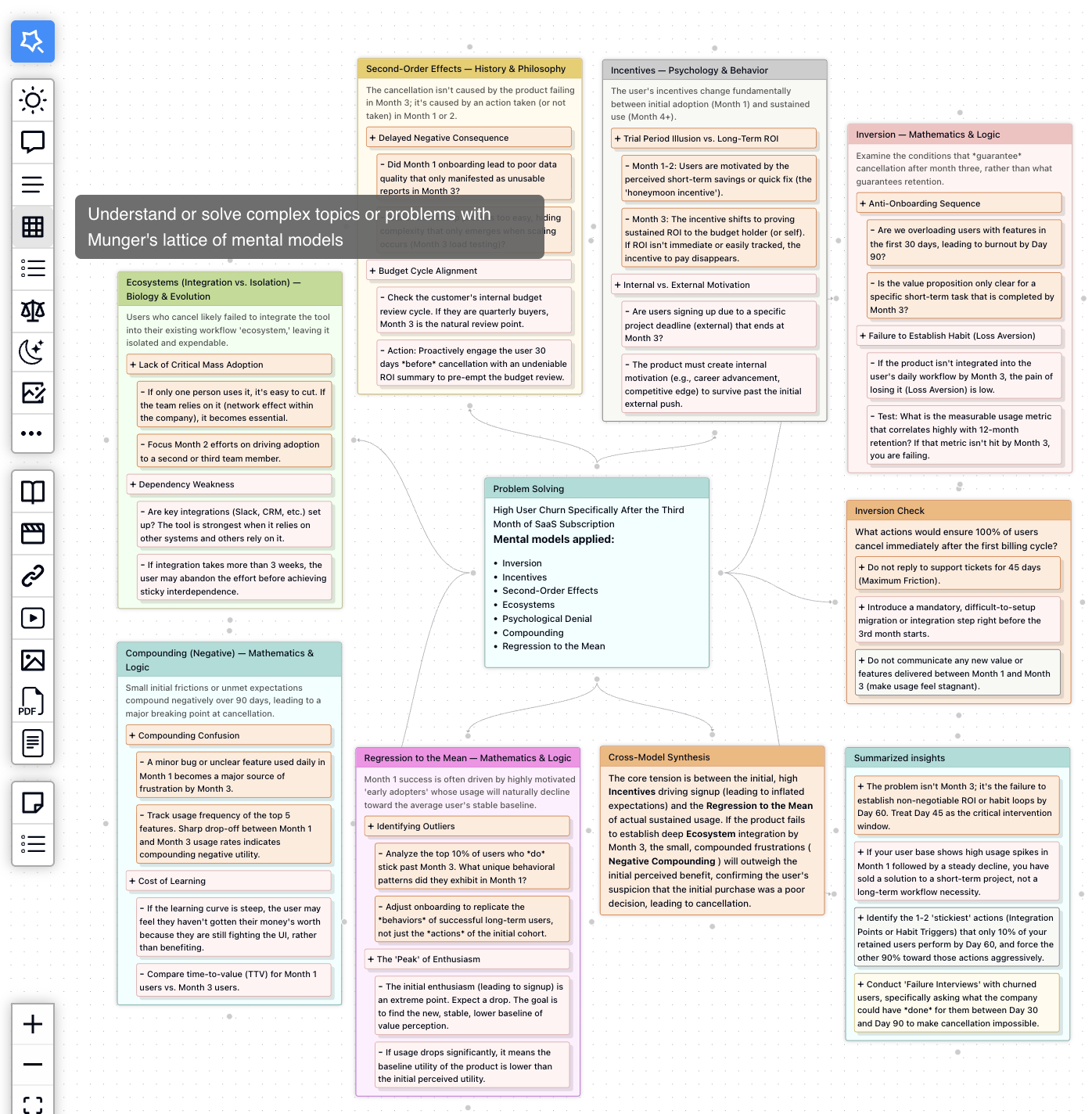
What Makes AIFlow Different: Four Defining Features
1. Inversion First — Always
Munger's favorite thinking technique: "Invert, always invert."
Rather than only asking "how do I succeed?", inversion demands you first ask: "What would guarantee failure?"
AIFlow hard-codes this into every analysis. Before surfacing solutions, it runs an Inversion Check:
"What actions would make this problem significantly worse? What are the failure modes hiding in plain sight?"
For a user retention problem, inversion might reveal that your onboarding flow is systematically teaching users the wrong behaviors in their first 48 hours — something that no amount of feature improvement will fix. Avoiding failure is often more tractable than chasing success, and inversion makes the failure modes impossible to ignore.
2. Genuinely Cross-Disciplinary Perspectives — Not Just Relabeled Advice
Many tools claim "multiple perspectives." In practice, they recycle the same domain-specific thinking with different headers.
AIFlow enforces a strict quality standard: each mental model must illuminate a genuinely distinct facet of the problem. Cosmetic application — slapping a model name onto generic advice — doesn't pass.
Take the problem "Why does my SaaS product keep losing customers after month 3?" AIFlow might simultaneously apply:
- Feedback Loops (Systems Thinking): Where in the product cycle does disengagement trigger more disengagement?
- Loss Aversion (Behavioral Psychology): What psychological threshold are users crossing when they decide the switching cost is worth it?
- Ecosystem Adaptation (Biology): Has the product stopped evolving alongside the user's growing sophistication?
- Opportunity Cost (Economics): What is the hidden cost users are actually paying to stay — in time, friction, or cognitive load?
- Inversion (Logic): Which specific product decisions are systematically trained users to expect less?
- Second-Order Effects (Philosophy): What happens downstream when churned users talk to your prospects?
Each angle surfaces a different leverage point. Together, they form a map of the entire problem — not just one corner of it.
3. Cross-Model Synthesis: Where the Real Insight Lives
Individual models give you fragments. Synthesis gives you understanding.
After generating each model's analysis, AIFlow produces a Cross-Model Synthesis — a structured reflection on how the models interact:
- Where do multiple models converge on the same leverage point? (That convergence is your highest-priority action.)
- Where do models create tension with each other? (Those tensions are where the most important trade-offs live.)
For example: Feedback Loop analysis might tell you to add more in-app notifications to re-engage disengaged users. But Loss Aversion analysis might reveal that over-notification is already a top churn trigger. That tension — both models pointing at the same mechanism from opposite directions — is precisely the kind of non-obvious insight that changes decisions.
This synthesis step transforms a list of parallel analyses into a coherent, three-dimensional understanding of your problem.
4. Bold, Specific, Non-Obvious Insights — Not Generic Advice
AIFlow's summary insights are held to an explicit standard: they must be specific, actionable, and counterintuitive. Not filler. Not restatements of what you already knew.
The difference looks like this:
❌ "Improving user experience is important for retention."
✅ "Your retention problem isn't a feature gap — it's a structural incentive misalignment. Users experience no meaningful 'loss' signal in the first 72 hours, so there's no psychological anchor keeping them engaged. Fix the loss architecture before adding features."
❌ "Focus on your most impactful issues."
✅ "Power law analysis suggests your top 3 churn drivers likely account for 80%+ of the problem — but your current roadmap distributes effort evenly across 12 initiatives. Concentration, not balance, is the correct strategy here."
These are the insights worth paying for. The kind that reframe not just your solution, but your entire understanding of the problem.
Who Is AIFlow Built For?
Founders & Product Leaders — Diagnose growth ceilings, user behavior patterns, and competitive positioning with structured rigor instead of gut feel.
Investors & Strategy Analysts — Evaluate opportunities and risks through multiple disciplinary lenses before committing capital or direction.
Researchers & Academics — Explore complex topics across disciplinary boundaries, surfacing connections that siloed thinking misses.
Consultants & Advisors — Deliver structured, multi-dimensional analysis that goes beyond surface-level frameworks.
Anyone Facing High-Stakes Decisions — Career pivots, business strategy, life decisions that involve uncertainty, multiple variables, and consequences that ripple over time.
If your question has a straightforward answer, a search engine is enough. But if your problem involves competing variables, second-order effects, human behavior, and genuine uncertainty — that's exactly where AIFlow operates.
AIFlow vs. Standard AI Chat: A Direct Comparison
| Standard AI Chat | FunBlocks AIFlow |
|---|---|
| Single perspective | 6–8 cross-disciplinary models in parallel |
| Gives you answers | Builds your thinking framework |
| Linear text output | Structured, visual mind map |
| Generic, domain-specific advice | Bold, non-obvious, problem-specific insights |
| Positive framing only | Mandatory inversion check for failure modes |
| Models in isolation | Cross-model synthesis revealing tensions and convergence |
The Munger Standard
Munger once said: "I have no right to have an opinion unless I can state the arguments against my position better than the people who hold it."
That's an extraordinarily high bar for thinking. Most of us — and most AI tools — never come close to meeting it.
AIFlow doesn't claim to replicate Munger's 60 years of accumulated wisdom. But it does systematically force the kind of multi-model, cross-disciplinary, inversion-first thinking that Munger identified as the foundation of sound judgment. For the first time, that kind of structured intellectual rigor is accessible to anyone with a problem worth solving.
Try FunBlocks AIFlow
The most valuable thing AIFlow does isn't give you better answers. It gives you better questions — and a framework rigorous enough to actually work through them.
Enter any complex topic or problem you're wrestling with. Watch six to eight of history's most powerful thinking frameworks converge on it simultaneously. And discover what you weren't seeing before.
Some problems don't need more information. They need a better way of thinking.
Start thinking with AIFlow →
Keywords: Charlie Munger mental models, latticework of mental models, AI mind map generator, complex problem solving AI, cross-disciplinary thinking tool, FunBlocks AIFlow, inversion thinking, multi-model analysis, decision-making framework, mental models AI, strategic thinking tool, second-order thinking