Think Deeper, Innovate Faster: FunBlocks MindMax Now Supports First Principles Thinking
What separates incremental improvements from true breakthroughs? More often than not, it comes down to how you think about a problem — not just how hard you work on it.
Today, we're excited to announce that FunBlocks MindMax now includes a First Principles Thinking tool — a powerful new way to analyze complex problems, challenge hidden assumptions, and discover innovative solutions using AI and mind maps.
What Is First Principles Thinking?
First principles thinking is the practice of breaking a problem down to its most fundamental truths — stripping away assumptions, conventions, and "the way things have always been done" — and rebuilding your understanding from the ground up.
It's the mental model behind some of the most disruptive innovations in history:
- Elon Musk used it to slash rocket costs at SpaceX by questioning why rockets had to be built the way they always were.
- Richard Feynman used it to understand physics by deriving everything from basic principles rather than memorizing formulas.
- Jeff Bezos used it to reimagine retail, logistics, and cloud computing by asking what customers fundamentally need.
The approach is powerful — but applying it rigorously to real-world problems is hard. That's where FunBlocks MindMax comes in.
Introducing First Principles Thinking in MindMax
The new First Principles tool in MindMax combines AI reasoning, structured mind maps, and proven analytical frameworks to guide you through the full thinking process — from raw problem to breakthrough solution.
Here's how it works:
🔍 Step 1: Reframe the Problem
Before diving into solutions, MindMax helps you articulate the real problem — not the surface-level symptom, but the underlying challenge. This reframing alone often reveals that teams have been solving the wrong problem entirely.
⚗️ Step 2: Audit Your Assumptions
The AI surfaces every assumption baked into how you currently understand the problem and labels each one:
- 🔴 Hard Constraints — physical laws, mathematical limits, logical truths that cannot be changed
- 🟡 Soft Constraints — industry conventions, habits, legacy processes, and cost structures that can be challenged
Most people treat soft constraints as fixed. First principles thinking sets them free.
🧩 Step 3: Decompose to Fundamentals
MindMax guides a structured "5 Whys" decomposition, drilling down until you reach the irreducible core of your problem. The result is a clear mind map showing exactly what you're actually trying to solve.
💡 Step 4: Generate Tiered Solutions
Rather than jumping to a single answer, MindMax generates solutions across three levels:
| Tier | Approach | Expected Improvement |
|---|---|---|
| Incremental | Optimize within existing assumptions | 10–50% better |
| Reconstructive | Challenge 1–2 key assumptions | 2–5× better |
| Disruptive | Rebuild from first principles | 10× or more |
The disruptive tier is where real breakthroughs live — and it's often where AI thinking tools fall short. MindMax is specifically designed to reach it.
✅ Step 5: Validate with Rigor
Every promising solution gets stress-tested:
- The Feynman Test — can you explain why it works in simple terms?
- The Counterargument Test — what are the strongest reasons it could fail?
- The First Experiment — what's the smallest, cheapest way to validate the idea today?
Visualized as a Mind Map
One of the most unique aspects of MindMax's First Principles tool is that the entire analysis is visualized as an interactive mind map.
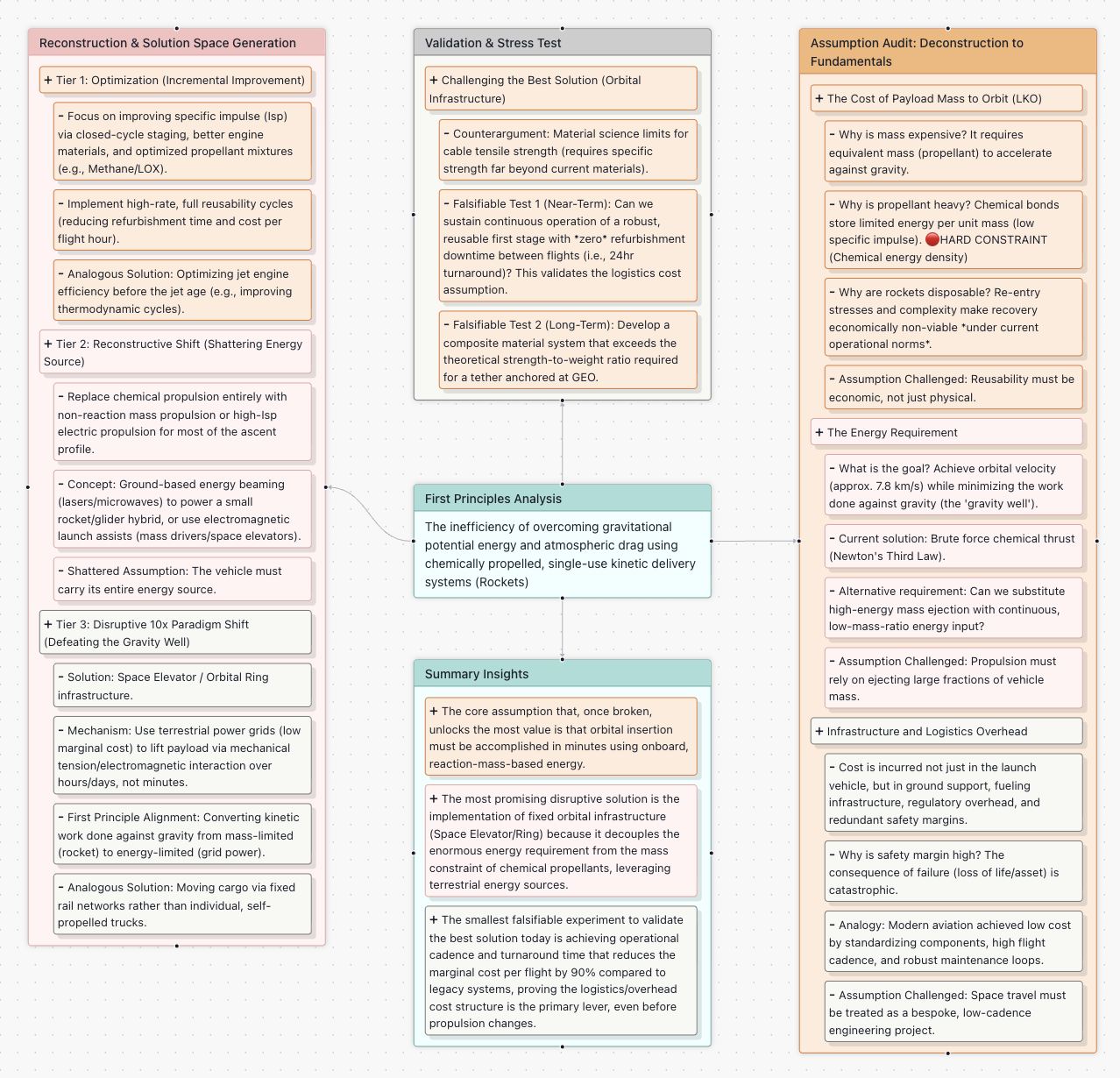
Instead of reading a wall of text, you see:
- The reframed problem at the center
- Assumption audit branches spreading outward
- Solution tiers color-coded by disruption level
- Validation checkpoints at the edges
This makes complex thinking navigable, shareable, and actionable — something a plain AI chatbot response can never achieve.
Who Is This For?
The First Principles Thinking tool in MindMax is built for:
- Product Managers trying to find the real reason users aren't converting
- Founders & Entrepreneurs looking for non-obvious market opportunities
- Engineers solving hard technical constraints
- Consultants & Strategists delivering insights beyond surface-level recommendations
- Researchers approaching problems without the bias of prior literature
- Anyone who wants to think more clearly and creatively
How to Use It
- Open FunBlocks AITools First Principles
- Or, open FunBlocks MindMax, create a new flow and select "First Principles Analysis" from the thinking tools menu
- Enter your problem or question
- Let MindMax generate the full mind map analysis
- Explore, edit, and expand branches interactively
- Export or share your analysis with your team
The entire process takes minutes, not days — and the structured output means your team can immediately act on the insights.
Why MindMax, Not Just ChatGPT?
You might wonder: can't I just ask an AI chatbot to apply first principles thinking?
You can. But you'll get a wall of text, no visual structure, no assumption labeling, no tiered solutions, and no easy way to explore or share the thinking with others.
MindMax is purpose-built for structured thinking workflows. The First Principles tool doesn't just generate text — it produces a living, interactive mind map that you can navigate, edit, and build on. It's the difference between a raw AI response and a thinking instrument.
Start Thinking from First Principles
The best solutions rarely come from doing the same things faster. They come from questioning whether you're doing the right things at all.
First Principles Thinking is one of the most powerful mental tools ever developed — and now it's available to everyone, powered by AI, inside FunBlocks MindMax.
Try First Principles Thinking in MindMax →
Have a complex problem you've been stuck on? Try the First Principles tool and share what you discover. We'd love to hear how it changes your thinking.